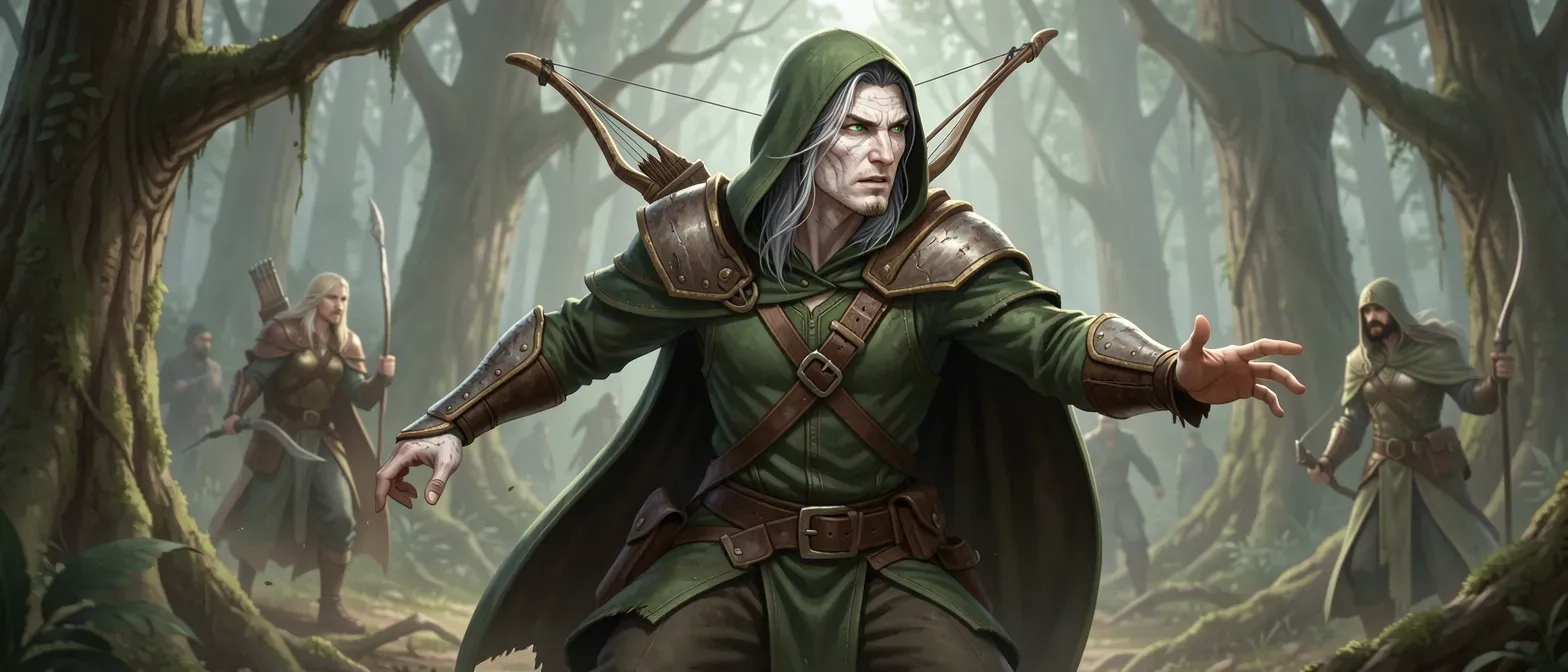
Lorindel Falthren moved through the shadowed boughs of the Eldergrove like a whisper on the wind, his lithe form blending seamlessly with the ancient woods that had cradled his people for centuries. At one hundred and forty-seven summers, he appeared no older than a human in his prime—early thirties, perhaps—with skin the pale hue of birch bark, etched faintly by the sun's dappled kiss through the canopy. His hair, a cascade of silver-threaded chestnut, fell unbound to his shoulders, often crowned with a circlet of woven vines that held a single hawk's feather, a token from his first hunt. Sharp emerald eyes, keen as a falcon's, missed nothing: the twitch of a deer's ear, the subtle shift of leaves betraying an intruder's step. He wore the garb of his kin, a tunic of supple leather dyed in mottled greens and browns, hooded cloak clasped with a carved wooden brooch depicting the eternal tree of Aeloria, and boots soft as moss that left no print on the forest floor. A longbow of heartwood, strung with sinew from the great stags, hung across his back, its quiver ever full of arrows fletched with raven feathers, each tip poisoned with the sap of nightbloom berries.
Born in the hidden glades of the Eldergrove, Lorindel was no ordinary wood elf; he was a Waywatcher, sworn guardian of the borders where the wild heart of the forest met the encroaching steel of men and dwarves. From boyhood, he had learned the tongue of trees and the secrets of the undergrowth, his days spent in vigilant patrol, his nights haunted by the ghosts of felled groves. What drove him, deep in the marrow of his bones, was the unyielding desire to preserve the sanctity of Aeloria's realm, to ensure that the ancient songs of the woods echoed unbroken for generations yet unborn. Yet this quest was thwarted by the creeping blight from the south—a foul corruption seeping from the Ironspike Mountains, where dwarven forges belched smoke that withered leaves and twisted roots into agony. Worse still, whispers among his own kin spoke of uneasy alliances with the very defilers, tempting some elves with promises of power in a changing world.
Lorindel could not abide such betrayal; it clawed at him like thorns in his flesh. He responded with the cunning of the wild: silent ambushes on supply lines, illusions woven from shadow-moss to mislead scouts, and arrows that felled leaders from afar. His unique quirk set him apart even among his watchful brethren—a soft, melodic hum that escaped his lips unbidden when deep in thought, an old lullaby from his mother's cradle that mimicked the rustle of leaves, disarming foes who mistook it for the wind until his blade found their throat. This method worked because Lorindel knew the forest as an extension of himself; its veins were his paths, its breaths his warnings. He anticipated the enemy's moves like a predator sensing fear-sweat, turning the terrain into an ally that swallowed armies whole.
But conflicts gnawed at his spirit: the pull between unyielding duty and the ache of isolation, for Waywatchers forged few bonds, their lives a solitary vigil. A scarred memory lingered from his youth, when raiders slew his sister before his untrained eyes, fueling a rage that sometimes blinded him to mercy. In the end, his arc bent toward a pyrrhic dawn—victory against the blight's vanguard, but at the cost of kin divided and a forest scarred, leaving Lorindel to wander deeper into the wilds, his hum now laced with sorrow, forever the sentinel in a world that refused to stand still.