Conrad Ward, 'The Ledger-Keeper'

Level 3 Human Warlock (The Buyer (custom patron โ€” a distant, coin-and-chain-marked entity of debts and bound labor))

Available with DM subscription
Register to save this character forever!

This character will be deleted in 6 days. Create a free account to claim all your generated content.

STR
8 (-1)
DEX
15 (+2)
CON
14 (+2)
INT
13 (+1)
WIS
10
CHA
16 (+3)

Defense

Armor Class 14 (Leather armor (11) + Dexterity (3))
Hit Points 24 (3d8 + 6 (10 at 1st level, +7 each level after) +2)
Speed 30 ft.

Proficiencies & Skills

Saving Throws wisdom, charisma
Skills Stealth +4, Survival +2, Deception +5, Intimidation +5, Investigation +3, Sleight of hand +4

Features

Patron's Boons: Pact of the Tome

class Level 3
at will

Conrad's Book of Shadows is the chained leather ledger itself. It holds his patron's magic (three extra cantrips: Message, True Strike, and the custom Name-Binding cantrip below) and the names of every bound signatory. If the ledger is taken or destroyed, the bindings weaken: bound prisoners can remember their names, and Conrad loses access to Name-Binding until he reclaims it.

Terms of Collection (custom)

custom Level 1
1/day

As a bonus action, Conrad names a creature he can see that has signed his ledger. Until the end of its next turn, that creature has disadvantage on saving throws against his spells and cannot willingly attack him. A creature that has never signed anything of his is unaffected. (Custom boss mechanic; balanced against Hex/Command-tier effects.)

Otherworldly Patron: The Buyer (custom)

custom Level 1
at will

Conrad's patron is 'the Buyer,' a distant entity whose letters arrive sealed in black wax stamped with a coin-and-chain mark. The Buyer's gifts are contractual: Conrad's magic is drawn from signed obligations, not raw will. Expanded spell list (custom, SRD-balanced): Charm Person, Dissonant Whispers, Command, Suggestion.

The Chained Ledger (custom)

custom Level 1
special

A leather ledger chained to Conrad's wrist. It holds bound names and signed deeds. Breaking a binding requires the book, a remove curse, or a DC 15 Intelligence (Arcana) ritual performed with the open book. The chain (AC 19, 15 HP) must be broken to take the book from him.

The Porcelain Half-Mask (custom)

custom Level 1
special

A smooth white half-mask that hides Conrad's face from anyone who has signed his book. Bound creatures cannot recognize or describe him; Ellyn Cartwright, who never signed, can identify his voice as Conrad Ward, the dismissed temple clerk of Waukeen.

Feats: Alert

background Level 1
special

Conrad adds his proficiency bonus (+2) to initiative rolls and can swap initiative with a willing ally after rolling. As a boss, he always acts first โ€” opening with terms, not blows.

Eldritch Invocation: Devil's Sight

class Level 2
at will

Conrad sees normally in dim light within 120 feet, and magical darkness does not impede his vision โ€” useful in lantern-smoked mine galleries.

Magical Cunning

class Level 2
1/day

Conrad performs an esoteric rite on himself (1 minute) to regain one expended pact magic slot. He cannot use this again until the next dawn.

Pact Magic

class Level 1
special

Conrad's spellcasting uses Charisma. He has two 2nd-level pact magic slots, restored on a Short or Long Rest.

Eldritch Invocation: Agonizing Blast

class Level 2
at will

Eldritch Blast gains +3 damage per bolt (Charisma modifier).

Spellcasting

charisma DC 14 +5 to hit Level 1: 0 slots Level 2: 2 slots

Pact Magic: 2 slots, both 2nd level, recovered on Short or Long Rest; Magical Cunning restores one slot once per dawn. Conrad upcasts 1st-level spells in 2nd-level slots freely.

Eldritch Blast

Cantrip class
evocation 1 action 120 ft V, S

A beam of crackling force. One bolt (two at level 5+), 1d10 force damage each; +3 per bolt from Agonizing Blast. In play, Conrad uses this as a polite, clinical 'correction' rather than an attack.

Minor Illusion

Cantrip class
illusion 1 action 30 ft S, M

Conrad conjures a sound or image โ€” the scratch of a quill, a voice counting names โ€” to mislead and unnerve clients.

Message

Cantrip pact_of_the_tome
transmutation 1 action 180 ft V, S, M

Conrad whispers terms to a target through the mine's smoke and stone; the target can reply. He uses it to negotiate with parties who have split up.

Name-Binding (custom)

Cantrip pact_of_the_tome Custom
necromancy 1 action 30 ft V, S

Conrad speaks a creature's true name aloud. The target must succeed on a DC 14 Wisdom saving throw or be unable to speak its own name or reveal any information about itself until the end of its next turn, and it has disadvantage on its next attack roll. A creature that knows and cherishes its name (or has been freed from a binding) has advantage on the save. This is the seed of his binding rite, not the full rite itself.

Charm Person

Level 1 patron
enchantment 1 action 30 ft V, S

A humanoid is charmed (Wisdom save negates) and regards Conrad as a friendly acquaintance โ€” 'a client being shown terms.'

Dissonant Whispers

Level 1 patron
illusion 1 action 60 ft V

3d6 psychic damage on a failed Wisdom save (half on success), and the target must use its reaction to move away. Conrad describes it as 'the sound of a debt being called in.'

Hex

Level 1 class
enchantment 1 bonus action 90 ft V, S, M

Conrad marks a target: +1d6 necrotic damage on his hits against it, and the target has disadvantage on ability checks with a chosen ability (usually Dexterity, to slow it in the flooded galleries).

Command

Level 1 patron
enchantment 1 action 60 ft V, M

One-word orders โ€” 'Sign.' 'Stay.' 'Drop.' โ€” on a failed Wisdom save. A favorite clause of the Buyer's contract language.

Misty Step

Level 2 class
conjuration 1 bonus action Self V

Conrad teleports 30 feet โ€” through a barred gallery door, up the shaft ladder, or away from a cornered fight toward the flooded shaft.

Behind the character

Character Information

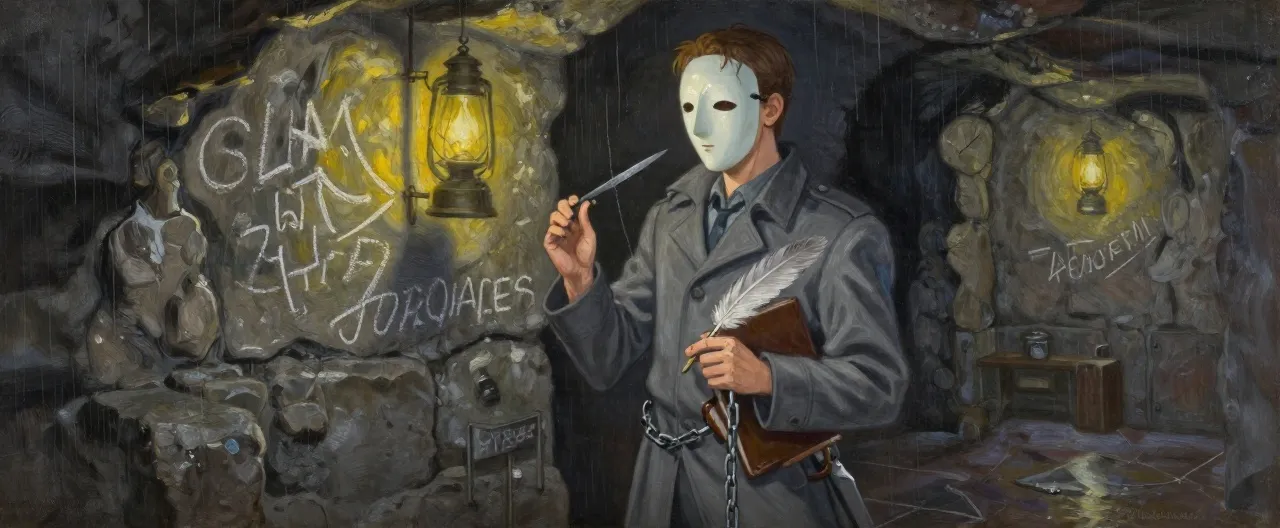
Conrad Ward, called the Ledger-Keeper, is a lean, unhurried man of about forty who dresses like a clerk and negotiates like a temple: measured, formal, and faintly liturgical. He wears a plain grey wool coat buttoned to the collar, salt-stained at the hem, and a smooth porcelain half-mask that hides the upper half of his face โ€” blank, faintly glossy, expressionless โ€” leaving only a thin mouth and a well-kept jaw.

His fingers are ink-stained despite careful grooming, and a heavy leather ledger hangs from a short chain locked around his left wrist; he touches it the way other men touch holy symbols. He smells of lamp oil, salt, and sealing wax.

He addresses everyone as 'client,' including people actively trying to kill him, and he has never once raised his voice โ€” he considers shouting a breach of professional etiquette. He taps the chained ledger twice before making any offer, as if knocking on a door, and he writes mid-conversation in a neat, unfamiliar clerk's hand: names, offers, threats, all recorded with the same calm diligence. He counts under his breath when calculating โ€” 'one name, two names, three names signed' โ€” and the habit is more unsettling than any threat could be.

Conrad is genuinely offended by broken contracts and genuinely delighted by a clever clause; he will pause mid-combat to admire a well-worded threat. He believes every person has a price, and that a name freely signed is the cleanest coin of all. He treats violence as a failed negotiation โ€” a personal embarrassment, not a moral issue โ€” and he takes a percentage of every bargain, keeping meticulous, honest accounts of his own dishonesty.

At half health or out of leverage, his tone cools into brisk, almost relieved practicality: 'Let us discuss settlement, client. I can be very reasonable.' Beneath the mask and the manners is a dismissed temple clerk of Waukeen who learned that the most powerful magic in any market town is not a spell, but a signature.

Before the adventure

Character Background

Conrad Ward was born in a market town not unlike Saltpans, the son of a toll-keeper who taught him one lesson before anything else: everything is counted, and whoever keeps the count owns the road. He was clever with figures and better with handwriting, and at sixteen he was taken into the shrine of Waukeen as a tithe clerk โ€” a boy with ink-stained cuffs and a silver coin pendant of his own, copying names into rolls that determined who paid what, and to whom.

For fifteen years he was a good clerk. He learned the temple's ledgers, the town's debts, the ferry tolls, the salt sacks stamped with the factor's mark. He learned that the rolls of names were not records; they were instruments. A name entered in the right column, at the right time, could move coin, property, and reputations without a single lie being told. Waukeen's faith taught that honest commerce was worship, and Conrad came to believe a darker corollary: that the ledger was the real temple, and the goddess merely its most respected client.

His fall was small and enormous at once. He altered a tithe roll โ€” a few entries, a few names shifted between columns, skimming the shrine's poor-box by paper rather than by hand. He told himself it was a loan. The temple disagreed. He was dismissed publicly, quietly, and completely: name struck from the rolls, credentials revoked, and a dismissal writ filed in the shrine's locked archive under a false year so that no future employer could ever verify what he had been. He walked south with nothing but a ledger and, within the month, a letter that arrived sealed in black wax, stamped with a coin and a chain.

The letter did not offer him a job. It itemized his debt โ€” the altered entries, the skimmed coin, the forged year โ€” and noted, with a senior clerk's dry precision, that he had already signed the first page himself, in his own neat hand, the night he made the alterations. The Buyer, whatever it is, collects obligations that people sign against themselves. Conrad's shame was the contract; the mask, which arrived in the second letter, was the uniform. He has worn it for three years and no longer knows, in lantern smoke, where the porcelain ends.

His territory is the South Downs: Saltpans, Taren Ferry, the old salt road, and the worked-out Old Salt Mine beneath the chalk, whose flooded lower gallery serves as his holding room and whose ledger room holds his strongbox of black-wax letters. His method is patient and blade-free. He identifies what a person owes โ€” money, shame, fear, a brother's safety โ€” and offers terms. Those who sign return 'quiet,' bound by ink marks they cannot remember making, unable to speak their own names or refuse his requests.

Six frightened townsfolk are already his, Adam Cartwright's signature is secured on a deed he does not remember, and the ferryman Ross Butcher cuts the chain on orders because his brother Tam is held below.

Conrad tells himself he deals in paper, not people โ€” that his previous shipments were deeds and debts, not souls. The unsent strongbox, the unsigned manifest, and the blank final page he keeps in his ledger suggest a man standing at his own line, counting. He wants a partnership stake, a clean close on the Cartwright entry, and โ€” more than he will ever write down โ€” to be owed something by someone who does not hate him.

He is a middleman, and he knows it, and the last black-wax letter used the word 'delinquent' for the first time. Somewhere south, an auditor is being prepared, and Conrad Ward, meticulous accountant of his own dishonesty, has already entered the cost of that in his books.
Threads to follow

Unresolved Plots

  • The shrine's poor-box has been emptied nightly for a week, and the watch has been paid to look away. Conrad has been skimming Waukeen's tithes โ€” the same crime that got him dismissed โ€” to fund the enforcers' wages. If the theft is traced, it connects the temple, the watch, and the mine in one tidy line of corruption.
  • The new ferry chain links were forged with a temple stamp, meaning someone with shrine access supplied the mark. That someone is Conrad, using his old clerk's credentials โ€” but a second stamp impression exists, suggesting a temple insider still helps him, and it is not Harriet Miller.
  • Conrad's letters mention a 'rival collector' he invented to stall the Buyer โ€” but the last black-wax reply congratulates him on 'confirming the rival's territory.' Either the Buyer is testing him, or a real rival collector is genuinely working the downs, and Conrad dreads finding out which.
  • Tam Butcher, while bound, saw the face of the network's previous agent โ€” a woman who worked this territory before Conrad and who, per the letters, 'retired south under audit.' Her fate is the Buyer's warning to him, and her name is written on a page Conrad keeps folded and unopened.
  • The flooded lower gallery holds more than the strongbox: old chalk scrawls of names from the mine's working days, and beneath them, older marks in a hand that predates the town โ€” something was bound in this mine long before Conrad brought his ledger, and it has been patient.

Beneath the surface

Secrets

  • Conrad's own name is the first entry in his chained ledger, signed the night of his dismissal. The Buyer did not approach him with an offer; it collected a debt he had already signed against himself with a forged tithe roll, and every 'gift' since has been a repayment schedule.
  • Conrad has never actually sent a full manifest of bound labor south. Previous shipments were lists of deeds and debts only โ€” paper, not people. The strongbox delay is partly stalling and partly the line he has not yet crossed, and he tells himself the distinction matters.
  • The porcelain half-mask is not Conrad's. It arrived in the first black-wax letter, already worn smooth, with a note reading 'the previous agent's.' He wears a dead woman's face, and he does not know whose it was โ€” only that the bound cannot see past it, and sometimes, in lantern smoke, he thinks it fits too well.

What haunts them

Fears

  • Conrad fears the auditor. The network's letters make clear what happens to delinquent agents, and he has read enough of them to know the audit is not an investigation โ€” it is a collection, and the debt collected is the agent himself.
  • He fears his own ledger's first page. If his signature can be unbound the way he unbinds others, then everything he has built โ€” the mask, the mine, the percentages โ€” rests on a name he could lose as easily as his clients lost theirs.
  • He fears Ellyn Cartwright saying his name in the market square. Not because it exposes him, but because he suspects that if enough people who never signed say 'Conrad Ward' aloud, the mask will stop working โ€” and he does not know what is underneath it anymore.

What drives them

Aspirations

  • Conrad wants a partnership stake: to stop being the Buyer's clerk and become a principal โ€” owner of the salt rights, the ferry tolls, and the Cartwright holdings, with the network as his client instead of his master.
  • He wants to close the Cartwright entry cleanly. Ellyn's unsigned, unbound existence is the one flaw in his ledger, and he privately believes that if he can either bind her or earn her signature freely, his system will be proven perfect.
  • More than he admits, he wants to be owed something by someone who does not hate him โ€” a debt freely given, like Joel's old meal, that no contract could ever collect. He keeps a blank final page in the ledger for it, and has never written on it.

Personal quest ยท 1

The First Signature

Conrad's earliest entry in the chained ledger is his own name, signed the night he was dismissed from the temple of Waukeen for altering the tithe rolls. He believes that if he can recover the original dismissal writ from the shrine's locked archive and burn it, the binding on his own soul will loosen and the Buyer's claim on him will weaken. The writ is guarded by Harriet Miller, who does not know what she is protecting.

Current Stage

Conrad learns the dismissal writ still exists in the shrine's poor-box archive, misfiled under a false year.

Choice
Send enforcers to steal it by night, or forge a temple summons to have it handed over lawfully.
A theft leaves evidence pointing to the mine; a forgery risks Harriet recognizing the clerk's hand.
Mechanical Rewards
  • Custom boon: +1 pact magic slot per short rest (burn path) or a one-time auto-success escape clause (keep path)
  • Party learns the binding-breaking ritual on defeat or bargain
Narrative Rewards
  • Conrad's true origin and the nature of the Buyer's contracts are revealed
  • Harriet Miller's name is cleared of suspicion regarding the altered rolls

Personal quest ยท 2

The Unsent Strongbox

The flooded lower gallery of the Old Salt Mine hides a sealed strongbox of deeds and names that Conrad has collected but never sent south to the Buyer โ€” including the Cartwright salt rights and six bound townsfolk. The Buyer's latest black-wax letter demands shipment within the month. Conrad has been stalling, because once the box is sent, Saltpans is finished and his percentage becomes a salary.

Current Stage

Conrad delays the shipment, forging excuses in letters that grow increasingly nervous in tone.

Choice
Blame the closed ferry and the party's interference, or invent a rival collector working the downs.
The ferry excuse is plausible but invites the Buyer to send its own agents; the rival lie must be maintained.
Mechanical Rewards
  • Buyer's Favor (advantage vs. the Buyer's agents) or a second use of Terms of Collection, depending on choices
  • The strongbox deeds can transfer the Cartwright salt rights โ€” worth 500 gp in trade or leverage
Narrative Rewards
  • The full scope of Conrad's operation is revealed
  • Ellyn Cartwright's fate hangs on the unsent manifest

Personal quest ยท 3

Settlement with the Ferryman

Ross Butcher's brother Tam is among the bound, held in the mine's flooded gallery. Ross cut the ferry chain under duress and has been paying Conrad a 'toll' every week to keep Tam's name out of the manifest. Conrad respects Ross โ€” one of the few clients who has never once tried to renegotiate โ€” and the arrangement weighs on him more than he admits.

Current Stage

Conrad reviews the toll ledger and realizes Ross has paid more than Tam's original debt was ever worth.

Choice
Forgive the excess quietly, or apply it toward freeing Tam outright.
Forgiveness keeps the arrangement profitable; applying it frees a man Conrad would rather keep bound.
Mechanical Rewards
  • Innate Devil's Sight (comply path) or a freed Tam Butcher as a campaign ally (apply path)
  • Potential loss of binding power over the Butchers โ€” a permanent, meaningful restriction
Narrative Rewards
  • Ross Butcher's full testimony and the truth of the ferry chain
  • A rare glimpse of Conrad's buried conscience

Major Decision

Context

Cornered at half hit points in the ledger room, Conrad offers the party a truce: the Buyer's true name and the contents of the strongbox in exchange for his life and safe passage out of Saltpans.

Choice Made
Accept the truce, refuse and fight to the end, or accept and then break it once the letters are in hand.
Impact

Accepting turns Conrad into a reluctant informant with knowledge of the Buyer's southern network โ€” he can identify agents, forgeries, and sealed letters for the rest of the campaign, and gains the custom feature Repentant Clerk (advantage on Investigation and Arcana checks involving contracts and bindings), but he can never bind another name: Name-Binding and Terms of Collection are permanently lost. Refusing keeps him a full boss with all abilities intact but kills the intelligence source.

Breaking the truce grants the party the letters but marks them โ€” the Buyer's next letters address the party by name, and Conrad, if he survives, becomes a vengeful enemy with advantage on all attacks against the party (Settled Grudge, custom).

Major Decision

Context

During the confrontation, the chained ledger can be taken from Conrad if the chain (AC 19, 15 HP) is broken. The book holds every bound name in Saltpans.

Choice Made
Destroy the ledger, use it to break the bindings via ritual, or have a party member claim and sign it.
Impact

Destroying the ledger frees every bound person instantly but erases the signed deeds โ€” the Cartwright salt rights and the evidence against the Buyer vanish, and Conrad loses Pact of the Tome's extra cantrips until he reclaims a new book (his spell slots remain). Using it ritually (DC 15 Arcana with the open book) frees the prisoners and preserves the deeds as evidence. Claiming it is the dangerous path: the signer gains the custom feature Debtor's Voice (once per day, command a creature that owes them something, as Command, no slot), but their own name is now written in the Buyer's ledger, and Conrad's Terms of Collection works against them without requiring a signature.

Major Decision

Context

If bargained with or captured alive, Conrad reveals that his patron's contracts bind through shame and debt as much as ink โ€” and that Ellyn Cartwright, who never signed, is the only person in the mine the Buyer's magic cannot touch.

Choice Made
Turn Conrad over to the town watch, execute him, or press him into service as an informant under a contract the party writes.
Impact

The watch path is lawful but slow โ€” Conrad escapes or is broken out by a Buyer agent within days unless the party intervenes, and Saltpans' watch gains +2 morale for the lawful outcome. Execution is final but Harriet Miller and Berenice Lawson will always believe the party chose murder over justice, straining town trust. The contract path is the boldest: the party writes terms Conrad signs, gaining him as a permanent reluctant informant (he must answer one question truthfully per long rest, enforced by the contract), but any party member who drafts the contract must sign it themselves โ€” and Conrad, meticulous clerk that he is, will find the loophole in whatever they write.

Transformative Moment

Trigger

First time Conrad's mask is removed by someone who has signed his book

Transformation

The bound cannot perceive his face โ€” they see the mask even when it is gone. Only Ellyn and the party see Conrad Ward's tired, ordinary features, and the gap between the man and the mask becomes the campaign's quiet thesis: the Buyer's power works because people sign away the right to see clearly.

Mechanical Changes

The Porcelain Half-Mask

If the mask is destroyed, bound creatures within 30 feet can hear Conrad's true voice and gain advantage on saving throws against his enchantment spells for 24 hours.

The mask is a component of the binding's authority, not just a disguise.

Ally

Joel Palmer

Relationship uneasy ally
Influence 4/10
Loyalty 5/10

Shared History

Joel Palmer's wayhouse sits on the old salt road, and for three years Conrad has paid him a quiet stipend to look the other way when 'quiet' travelers passed through โ€” bound folk walking south in a daze, and later walking north again, emptier. Joel never asked what the stipend bought; he has a wooden leg, empty rooms, and a memory of better seasons, and silver is silver. But the arrangement has curdled.

Joel has sheltered three of the returned, watched them leave without paying, and finally understood what he was being paid to ignore. When Maya Cross arrived bound and silent, Joel stopped taking the money and started leaving a lantern burning in the window โ€” a signal to himself as much as anyone that he was done. Conrad knows the stipend stopped and has not yet decided whether Joel is a liability to be collected or a client to be renegotiated.

There is a genuine, unspoken respect between them: Joel is the only person in the region Conrad has never tried to bind, partly because the wayhouse is operationally vital, and partly โ€” though Conrad would never write this down โ€” because Joel fed him a hot meal once, years ago, when Conrad was still a dismissed clerk walking south with nothing but a ledger and a letter in black wax.

Potential Breaking Points

  • If the party protects the wayhouse from the enforcers, Joel will guide them to the winch tower and testify about the 'quiet ones.'
  • If Conrad offers to restore the stipend doubled, Joel's loyalty can be bought for exactly one night โ€” long enough for the enforcers to take Maya back.

Enemy

Ellyn Cartwright

Threat Level 3/10
Conflict Type witness and unfinished business

Personal Stakes

Ellyn Cartwright is the one entry in Conrad's ledger that refuses to close. She was taken for her father's salt rights โ€” a clean transaction, Adam's signature already secured โ€” but the girl herself never signed, and that omission has become a splinter in Conrad's professional pride. Worse, she has been listening. Through the mine's walls she has heard him speak of the Buyer, watched the black-wax letters pass, memorized the enforcers' patrols, and identified his voice: Conrad Ward, the temple clerk dismissed from Waukeen's shrine for altering the rolls.

She is the single person in Saltpans who can say his name and his crime in the same breath, and Conrad knows it. He has not bound her because binding requires a signature he cannot forge without breaking his own rules โ€” and because, on some level he does not examine, he admires her refusal. She, in turn, has decided that if she gets free, she will not run to her father first; she will stand in the market square and say 'Conrad Ward' out loud until the whole town hears it.

Conrad considers this a breach of professional etiquette. He has started keeping a separate, unofficial page for her โ€” not a contract, but a record of everything she has overheard, which is the closest thing to respect a man like him can offer an enemy.

Possible Resolutions

  • Ellyn freed and testifying: Conrad's identity is public, and his mask's authority collapses in town.
  • Ellyn bound before she speaks: her silence costs the party their best witness and hardens Adam Cartwright into the Buyer's most pliable asset.
  • Ellyn traded in a settlement: Conrad offers her freedom as part of his truce โ€” the one concession he makes without being asked.

Faction

The Buyer's Network (the coin-and-chain)

Standing 7/10

Influence

The coin-and-chain mark is the seal of a slaving network that trades in bound labor, operating out of a counting-house in a city far to the south, and Conrad is its sole agent on the South Downs โ€” a franchise of one. His standing is built on three years of clean percentages: names collected, deeds signed, shipments quiet, no drawn blades. The network's letters arrive monthly in black wax, and each one is both a compliment and a leash.

Conrad's influence within the network is real but narrow: he is trusted with territory, not with names. He does not know who sits behind the coin-and-chain seal, only that the letters read like the work of a senior clerk โ€” someone who was trained the same way he was, in a temple counting-house, and who learned the same lesson: that a ledger is holier than a sword. His recent stalling over the unsent strongbox has frayed that trust; the last letter used the word 'delinquent' for the first time.

If Conrad delivers Saltpans โ€” the salt rights, the Cartwright holdings, a manifest of bound labor โ€” his standing rises and he expects a partnership stake. If the strongbox is lost or the manifest falsified, the network will not send soldiers; it will send an auditor, and Conrad knows from network letters what auditors do to delinquent agents. This fear shapes every choice he makes in Act I, and it is why he offers the Buyer's name at half health: a middleman who has lost his territory is worth more alive as an informant than dead as an example.

Obligations

  • Monthly shipment manifest of names, deeds, and percentages, sealed in black wax
  • Territory report on Saltpans' salt production and ferry traffic
  • No unsanctioned violence โ€” the network trades in signatures, not blood

Benefits

  • Expanded spell list granted through the patron bond (Charm Person, Dissonant Whispers, Command, Suggestion)
  • Enforcer rotation supplied through network contacts
  • Legal cover: forged temple stamps and network-brokered deeds

Ready to Unleash Your Character's Full Potential?

Join thousands of players and create rich, detailed character backgrounds with Fable Fiesta!

Register to unlock personal quests, relationships, and narrative hooks!

Sign Up Now - It's Free!

No credit card required. Start creating in minutes!