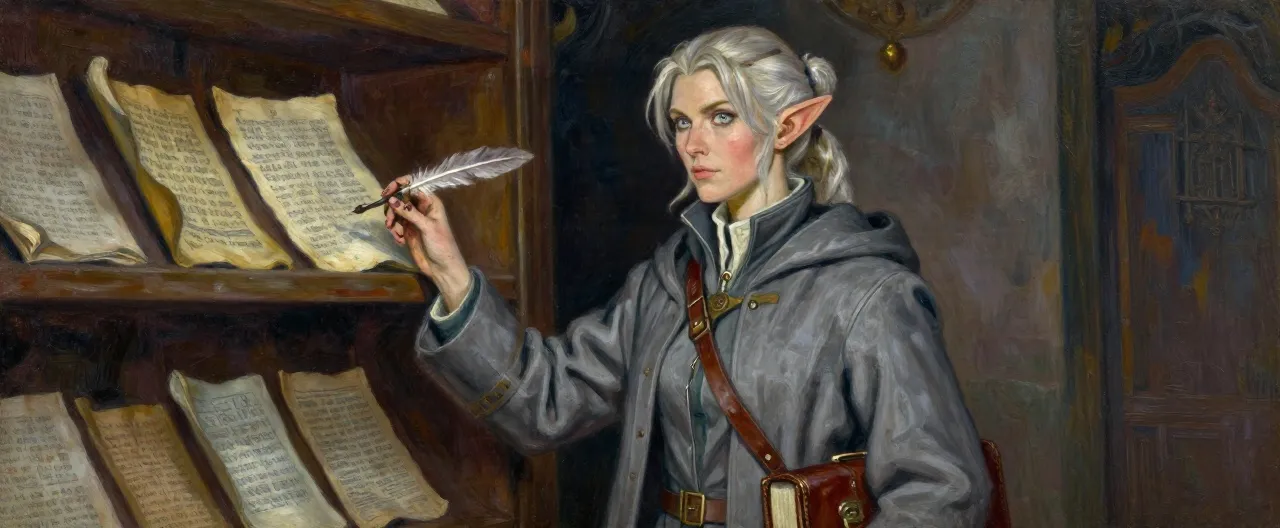
Orla was born in Lordinium, third daughter of a chandler's family with more respectability than money, and was apprenticed to the castle library at ninety — young for an elf, old for a copyist. Her grandmother had been a practice-hand for a scripture workshop and taught her to read the ghost of scraped letters by lamplight before she taught her to write her own name; Orla thought, for years, that every child learned this, and was corrected gently and often.
The castle library at Lordinium is a long stone room above the King's records, lit by high windows and lamps that are never trimmed enough. For thirty years Orla sat at the fourth desk from the window and inked clean copies of the official scriptures of the Twelve for the Crown's clerks. The work was exacting and dull and she was excellent at it. The scriptures describe the Seven Nations living on Borealis in harmony with the Twelve Gods, until a Thirteenth tried to take all power and was cast down; they carry a warning that any return will incur a price of blood. Orla copied that warning hundreds of times.
Then she began to notice. Her copies never quite matched the older vellum in the restricted cases — a word shifted here, a clause shortened there, and in eleven places, a line simply gone, the scrape so fine that only someone who had been taught to see ghosts could find it. She did what copyists do: she kept a ledger. A slim, salt-warped book titled in her own hand 'Discrepancies', recording every scraped line, its location, its probable date, and the ghost of what had been removed. She told herself it was professional habit. It was not. It was the beginning of an accusation.
Three years ago, Archivist Venn caught her at it — late shift, lamp low, ledger open — and did not report her. That silence frightened Orla more than a report would have, because it meant Venn already knew, and had chosen not to say so. Since then the two women have conducted an entire relationship in marginalia and misplaced comparison texts, and neither has said aloud what both know: the erasure was deliberate, ordered, and old.
The night Orla cannot explain is the ledger's twelfth entry — unwritten, but present in its absence. Five years before she began keeping records, a discrepancy appeared in a copy in her own handwriting. Either someone used her hands while she slept, or she scraped the line herself. The missing line was the blood-price warning. She has never shown anyone that page.
When Carl of the Seven Seas came home and called the warning a copying error, Orla read the phrase four times and then went to the docks to find work on his ship. A copying error has an author. She intends to find them, and she intends to put the proof in front of someone who cannot bury it — a court, a crowd, or a king. She is not particular. She packed her case, her pens, and a ledger chained shut at her hip, and signed the letter. The sea frightens her. The alternative — a clean page, quietly scraped — frightens her more.