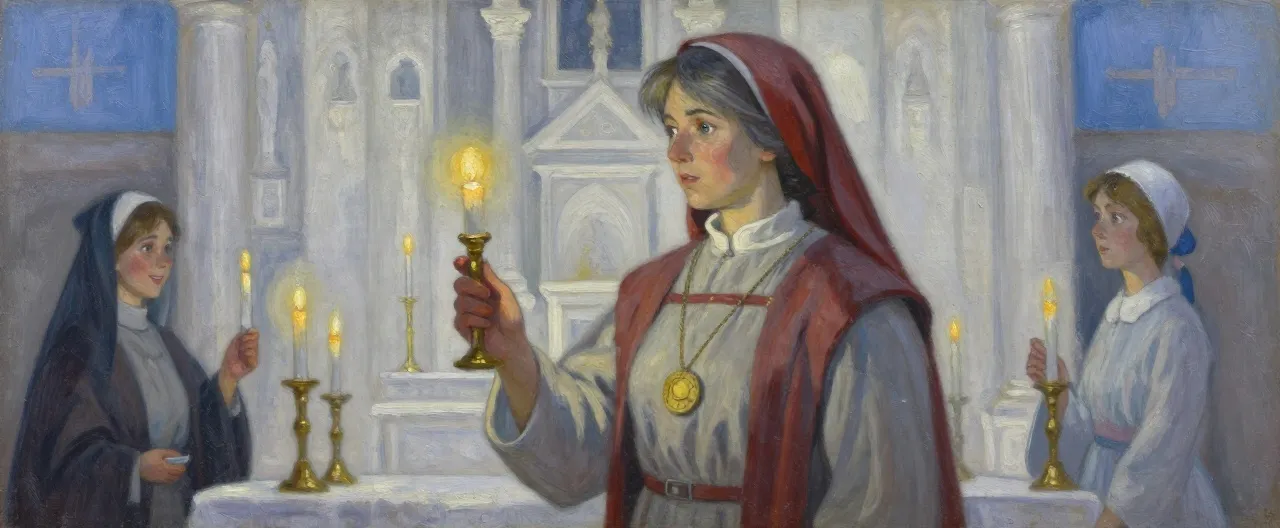
Ottiline Keene was born in a salt-poor village on the Verge thirty-one years before the campaign begins, the eldest of four children of a drover and a laundress. When the Ash Rot came through the Verge in her seventeenth year and took her parents in the same fortnight, she and her younger cousin Abel Warren were taken in by the Order of the Lamp's charity house at Valleyford. She took the hospitaler's vows at nineteen — the same year she bore a daughter she never named aloud, left at a Valleyford foundling house before her final profession.
She never spoke of the child again, and the Order never knew. For eleven years she served the Order faithfully: plague-wards, waystations, the long walks between. She was good at it in a way that frightened her superiors a little — she could sit with the dying for hours, sing to them, hold their hands, and then stand up and walk to the next bed without changing her face. They called it grace. It was actually arithmetic: the early habit of a mind that counted what could not be saved and moved on.
The outbreak that broke her came in her early thirties. The Ash Rot reached Castillo's lower city in the wet season, and the Almonry's plague-ward filled in four days. Ottiline nursed there for six weeks. She watched pilgrims who had walked a thousand miles to reach the holy city die in the streets within sight of the Basilica's dome, and she watched the chapter pray — organized, beautiful, entirely useless prayer — while the dead were stacked in the courtyard for want of ground to bury them.
She counted. Four hundred and eleven dead in six weeks, and the chapter's response was a sung litany and a fast day. On the forty-third night she went down into the vault beneath the High Altar, past the reliquary store, to the old stone the Basilica was built on — the black stone older than the building, carved with a sun on one face and a name on the other.
She knew what it was; the Lamp's oldest records call it a seal, and seals are made to hold something in. She put her hand on it and she spoke to what was underneath.
The thing beneath the altar answered. It called itself the Tallyman, and it was a glabrezu bound there before the Basilica was built, before the Cataclysm, by hands that understood what the badlands carried in their wind. The bargain Ottiline struck was simple and it has never changed: blood, regularly, in quantity, fed to the forge the Tallyman showed her how to kindle at the old Ironworks — and in exchange, the Ash Rot does not touch Castillo.
Not the city. Not the people inside the walls. The road, the villages, the travellers, the pilgrims: those were never part of the protection, and the Tallyman was careful to say so, and Ottiline was careful to hear it. She signed in her own blood on the altar stone itself, and the pact term was thirty years, renewable once, at the altar, at a consecration. She walked back up into the nave at dawn, washed, put on her habit, and reported for her shift in the ward as if nothing had happened. She has never told anyone what the vault floor felt like under her bare feet. She has never stopped feeling it.
She founded the Ashen Choir within the year. It began as seven people — hospitalers, waystation keepers, a Lamp acolyte named Hollis Crane who had lost his faith in a bad winter and found her arithmetic more honest than his hymns. They did not call it a cult. They called it the ward, and the road was the sickness, and the blood was the medicine. Ottiline ran it the way she had run the plague-ward: with ledgers, with rotas, with kindness at the bedside and cold efficiency in the counting.
She recruited Abel first, and he ran the numbers with her and asked for a posting in the city. She recruited Gresh Kettle second, because he already had the roads and she did not have to look at what he did to fill the contract. She learned early that she could not do the bleeding herself — her hands, the nurse's hands, refused — so she built a machine that would do it for her, and she called the machine mercy, and thirty years on she still believes, most days, that the word fits.
The forge has been burning at the Ironworks for six years, fed by barrels that cross the marsh stamped DYE and by people the Chain delivers by moon-phase. Silas Dean feeds it. Hollis Crane bleeds at it. Nell Perry bled at it until the night she was told to cut a child and ran. Ottiline has visited the forge exactly four times in six years. She does not like to go.
She stands at the edge of the pit and listens to it breathe, and she counts — silently, the old habit — how many names the ledger holds, and whether the arithmetic still balances, and whether the city she is saving would recognize the price. She does not sleep well. She hums the Choir's round when she thinks, which is worse than singing it, and she prays to Pelor in the Lamp's manner when she believes no one is watching, and she has kept her old sun-disc scratched bare because the scratching is the only prayer she trusts herself to mean.
The pact expires at the end of its thirtieth year. The renewal requires a consecration: the pact-bound must stand at the High Altar — which is to say, on the binding-stone itself — with the altar's sigils lit, a round-sung chant maintained, and three full rounds of uninterrupted ritual, and the renewal binds the forge's protection permanently to the altar and cannot be broken afterward without unmaking the altar itself.
Ottiline has spent a decade preparing for this. Abel Warren's climb toward the Luminar's seat is part of the preparation; the Choir's infiltration of the chapter is part of the preparation; the Headland camp's nightly harvest is part of the preparation. She does not want power. She has never wanted power. She wants Castillo to survive, and she has decided the road is a fair price, and the only thing that has changed in thirty years is that she has begun, very quietly and very late, to doubt whether the woman who decided that is still the woman she meant to be.