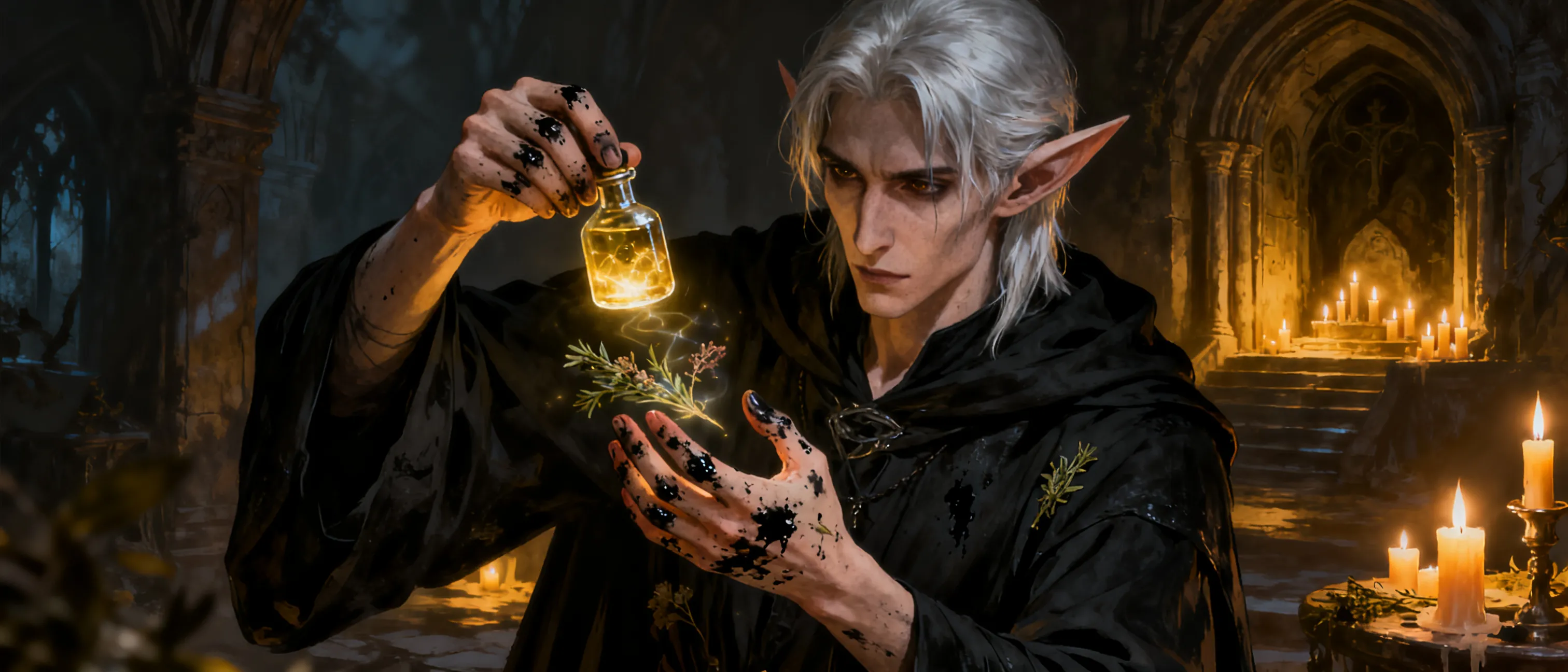
Character Background
Vaelith’s life began as a sacrament to murder. In 1360 DR, beneath the hidden cruelties of drow ritual and ambition, a profane rite was performed with the remains of Bhaal’s mortal avatar and the sacrifice of a pregnant drow cultist. From that violence, he was formed: not merely born, but assembled from blood, intent, and divine residue. If there was ever a moment when the world might have declared him doomed, it was then. Yet fate did not grant him the dignity of a clear destiny. Instead, he was abandoned on the streets of Menzoberranzan, where the city’s hunger, hierarchy, and suspicion taught him how little a life was worth unless it could be traded for usefulness.
He was taken in first as a servant to a noble house, an arrangement that was merciful only in comparison to the streets. He learned the etiquette of survival there: when to lower his eyes, when to answer, when silence was safer than honesty. Though he was treated as lesser, his unusual composure and quick understanding set him apart. A household that valued order more than compassion eventually placed him in a more specialized role, and he was apprenticed as a healer for the lower castes. The work suited him in ways no one expected. He had a natural steadiness around blood. He did not faint at the sight of crushed bone or infection. He could stitch, clean, mix tinctures, and set a splint with meticulous care. For the poor of the city, Vaelith became one of the few small mercies available to them.
But mercy was never the whole of him. Beneath the patient hands and measured voice lived something older, sharper, and more terrible: the Urge. It had not yet fully named itself to him as a child, but it watched, waited, and tightened like a wire around his thoughts. At age twelve, it broke free. In the slums where he lived, he murdered an entire family of poor drow. The details mattered less than the result. A line had been crossed, and whatever innocence he had been allowed—if any had ever truly existed—was gone. Horror followed horror: guilt, denial, panic, and the certainty that the city would eventually either execute him or use him. Vaelith chose neither. He fled Menzoberranzan with the speed of a cornered animal.
His flight carried him south and outward until he reached Baldur’s Gate, a city vast enough to hide a desperate youth and busy enough to ignore one more troubling shadow. There he was noticed by the Szarr family, and in particular by Dralia Szarr. She saw in him not a broken child, but an instrument waiting to be sharpened. She brought him into her orbit and then to the Szarr country estate in the Western Heartlands, where he encountered a different sort of education: one built on discipline, arcane theory, and the long patience of predatory mentorship. Under her instruction he began to study the arcane arts in earnest, discovering that magic offered him something he had never possessed before—structure. Where his blood demanded chaos, the spellbook demanded order.
In the intervals between lessons, Vaelith continued to practice healing. He treated minor injuries among the staff, preserved herbs, recorded symptoms, and sought to understand the body not only as flesh to be mended, but as a system that could be controlled. The combination of healer’s discipline and occult study made him unusually precise. He did not romanticize the work; he approached it as a craft, almost a confession. To mend was to control damage. To master magic was to control reality. To master himself—if that was even possible—would require both.
In the year 1460, Dralia gave him her dark gift and transformed him into a vampire spawn, and later into a true vampire by allowing him to feed from her. Those later years altered him profoundly, but they do not erase the younger man who existed before the transformation was complete: the frightened child, the gifted healer, the fugitive murderer, the promising student, and the soul caught between divine violence and disciplined learning. Vaelith’s bonds are complicated and often dangerous. He owes his survival to cruel patrons. He feels a warped loyalty to those who taught him, even while recognizing that their care was never free of possession. His ideal is control: over appetite, over magic, over the self. His flaw is that he believes every weakness can be solved by greater precision. The truth, which he fears, is that some hungers can only be lived with, not conquered.