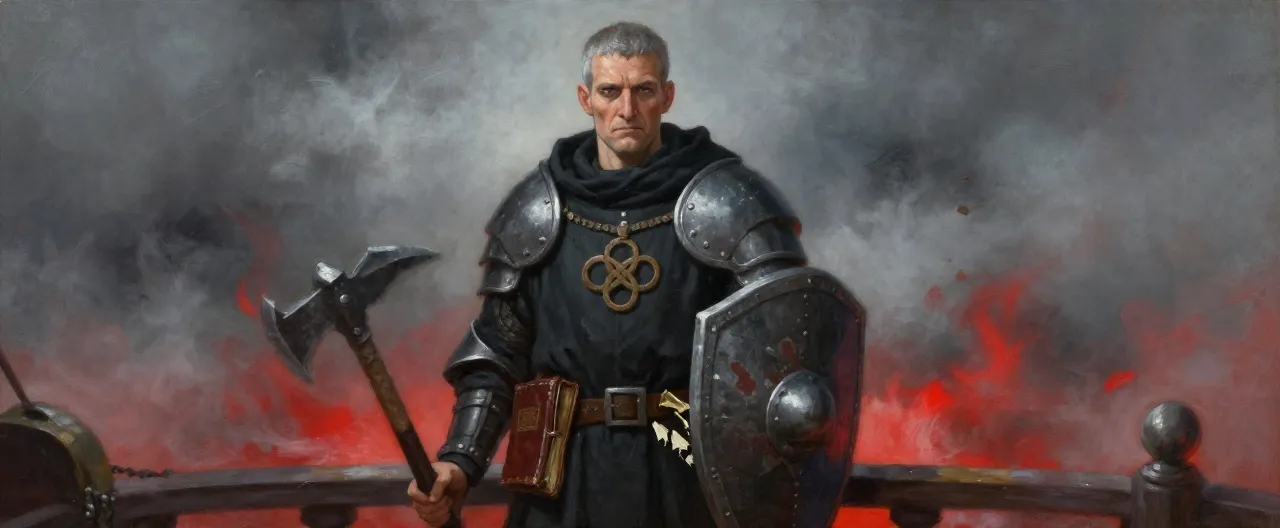
Anselm Tye was born in Harrowgate, the second son of a fishing family, and the sea took his father early and his brother Tomas later, off Gullclaw Cay, when Anselm was twenty-three and still too young to know that some graves stay open. The shrine of the Twelve took him in as an acolyte under old Priest Aldous, who fed him, taught him the rites, and never asked about the family the water had kept.
For twelve years Anselm was the shrine's steady hands: he trimmed the memorial candles, learned the register of the lost by heart, and sat with the dying because Aldous's hands were too heavy for the delicate work. He was, by every measure the shrine could measure, a good acolyte — and then Aldous's predecessor came home alone from the north, and began to scream.
Anselm sat the death-watch. Three days and three nights in a cold stone room with a man who had sailed with the first expedition and returned with his mind in pieces, raving about a wall of fog, about words that open it, about a price. On the second night the man was briefly, terribly lucid, looked straight at Anselm, and said two words: 'They signed.' Then the raving resumed, and among the ravings was a phrase Anselm wrote down and has never been able to unwrite: one life, freely given, every moon.
Anselm transcribed everything — the fog wall, the words, the price, the two words that undid him — and then, in the grey morning after the man died, he burned the original pages in the shrine's own candle flame and kept only his copy, torn into three pieces and hidden in the back of his prayer book. He did not stay for the funeral. He did not tell Aldous. He left in the night and did not stop walking for nine years.
Those nine years made him the man he is now. He buried sailors for coin in every port on the coast — Lordinium, Wexmouth, a dozen smaller harbors — keeping a private ledger of every body, every name, every ship. He performed the rites perfectly and felt nothing, and he knew he felt nothing, and he performed them perfectly anyway, because the alternative was to stop. He kept the predecessor's stolen signet ring on a cord under his cassock, a piece of proof he could never show anyone.
He refused, exactly once, a grey-robed priest's offer to bury a man off the books — and has been haunted by the priest's patient ash-grey face ever since. And once, on a becalmed night off Wexmouth, something answered a prayer he had not meant to pray, in the voice of a drowned man he had buried that same week, and told him he was doing its work better than theirs. He has never decided what that was. He has never told anyone.
Now Carl of the Seven Seas is hiring for the north, and the letter says the scriptures carry a warning that is probably a copying error. Anselm knows it is not a copying error, because he has the words in his prayer book. He signed on because the expedition sails toward the fog wall his dead man screamed about, toward the island the warning names, toward the answer to the question that hollowed him out: did the Twelve sign?
He tells himself he is going as a healer, because a crew of forty will need one, and that is true. He also knows that somewhere north of the ice is a wall of fog that takes one life from every ship, and that his three torn pages may be the only firsthand account of it in existence, and that the man who kept the journal that matches them is sitting in a shrine in Harrowgate waiting for a confession nine years overdue.
He is going north to find out whether his god is a liar, an accomplice, or a stranger — and he is terrified, in the quiet deliberate way he does everything, that the answer will be all three.