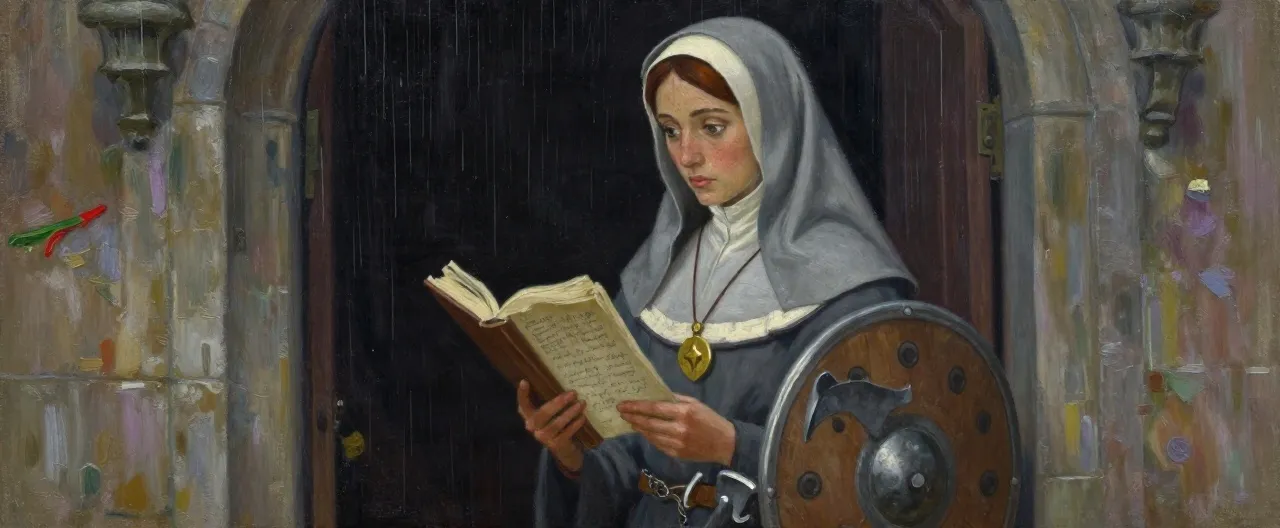
Corrin Ash was born in Greyharbor, the daughter of a rope-maker and a tide-woman who died of salt-sickness when Corrin was nine. She was given to the temple of the Twelve as a foundling in all but name, and Deacon Orwin raised her the way he did everything: carefully, kindly, and without ever looking too hard at the page. He taught her to read the scripture aloud, to copy it beautifully, and to love the sound of a complete sentence. He never once asked her to compare two copies.
She found the first erasure at nineteen. A hymnal in the temple's back shelf had a line about blood scraped down to a line about rain, and the scraping was old but the ink was not. She told no one. She started a private ledger instead, in a hand so small it looks like weathering: every difference she could find between the Cathedral's text and the fragments of older copies that survive in hymnals, funeral rolls, and the margins of prayer books nobody reads.
By twenty-three her ledger held sixty-one contradictions. She showed one to a visiting archivist, politely, as a question. Two weeks later she was reassigned to a country parish with a leaking roof and a congregation of eleven, and she understood that the question had been an answer.
She has spent the years since being exactly as obedient as she can afford to be. She prays, she heals, she keeps the parish rolls, and she collects differences. The Cathedral believes she has been corrected. She has not. When Peg Leg Carl's charter went up in Lordinium, she was already on the coast with a satchel of contradictions, and she signed because the expedition is going where the uncorrected text came from — to the island the scraped lines are about, with the Twelve whose names keep not matching their deeds.
Her faith is real and it is the problem. She does not want to be right about the erasures; she is more frightened of being wrong than of being hurt. She is patient with the people who cut the lines, because she believes most of them were afraid rather than wicked, and that patience is a discipline she maintains the way other people maintain a fast. She forgives the cutter.
She does not forgive the cut. She has begun, quietly and with enormous grief, to suspect that the Twelve she serves are not gods at all but something that has been eating, and that her whole tradition is a menu disguised as a hymnal.