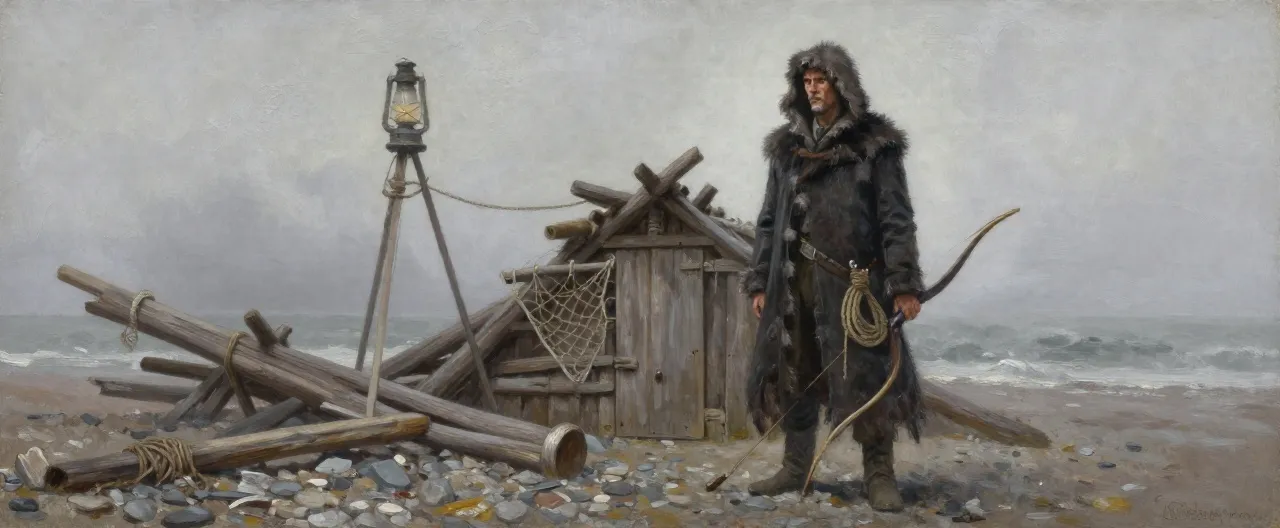
Ket Varn came to the Weeping Firth eleven years ago, walking north along the Crown Coast with a purse of silver he has never explained and a name that is not the one he was born with. He chose the Firth the way a knife chooses a sheath: it was the last stretch of coast before the fog, too poor for farmers, too dangerous for fishermen, and perfectly suited to a man whose trade requires that no one ask what he is doing on the beach at two in the morning with a lantern on a tripod.
The wrecker's trade is simple and old. You rig a false light where a safe harbour light should be, you let the tide and the reef do the killing, and you salvage what the Firth keeps. Ket is very good at it. He has a false beacon he can rig in ten minutes from mast timber and a lamp, trip-lines of tarred cord crossing a mile of shingle, and a pit trap for every hundred yards of beach — some of them his own work, some of them inherited from wreckers before him, all of them maintained with the devotion of a man who has made his bed in a trapfield and intends to die of old age in it.
He knows the Firth's tide-runs better than the harbour charts do, knows which wrecks are worth stripping and which are watched, and sells his salvage in Greyharbor through a fence who asks no questions because Ket pays in goods rather than gossip.
What the fence does not know — what no one on the coast knows — is that Ket's trade has a shadow side he has never reconciled. Nine ships on the teeth in eleven years. Most were fat merchantmen, insured, crewed by men who knew the risk. One was a fishing smack with a family aboard, wrecked in weather he did not cause but did not warn, and he has kept that entry separate on his tally-board ever since, scratched smaller than the others, as though smaller letters could make it a smaller thing. He tells himself the Firth kills, not him. The tally-board does not argue. It just lists.
His isolation is nearly total and largely chosen. The one exception is Sister Ivane, a missionary of the Twelve he pulled half-drowned from the surf five weeks ago after Kestrel Rook's wreckers put her ship ashore. She has prayed in his hut every evening since, and he has let her, and has noticed — with something between irritation and relief — that the nights she is awake, he does not rig the false light. He tells himself this is because a witness is bad for trade. He is aware, in the closed-off way of a man who does not examine his own motives, that this is not entirely why.
The shadow over everything is the fog. Ket has lived his whole Firth life under it, worked in it, profited from the ships it swallows, and never feared it — until eleven months ago, when he watched the Ashvane Concord's ship pass the Firth with a lantern burning at the masthead and no lights anywhere below decks, a ship full of ninety-odd souls sailing into the white wall like a man walking into a locked room on purpose.
Something about it — the discipline of it, the silence, the count of faces he made from the shingle and could not make add up — broke something in his certainty that the fog was just weather. Since then he has been afraid at dusk, afraid at low tide when the singing starts, and afraid most of all of the logbook he pulled from the buried ship's boat of the Sable Queen: a Concord supply vessel that came apart on the Firth's teeth three weeks ago with a crew that had been bled before it ever struck the reef.
He has the logbook. He cannot read the phonetic chant scrawled in its margin. He has buried it under the shingle rather than keep it in the hut, which tells anyone who knows him everything: Ket Varn prices everything, and this is the first thing he has ever been afraid to value.
Into this careful, trapped, arithmetic life come the party — hired hands on Peg Leg Carl's expedition, needing a heading through the fog and willing to pay for one. Ket will price them within a minute. What he cannot price, yet, is what they will ask him to become: not a wrecker, not a hermit, but a witness — the only man on the Crown Coast who has seen the fog's customer sail into it with his eyes open, and who might, if pushed, be persuaded to sail in after them.