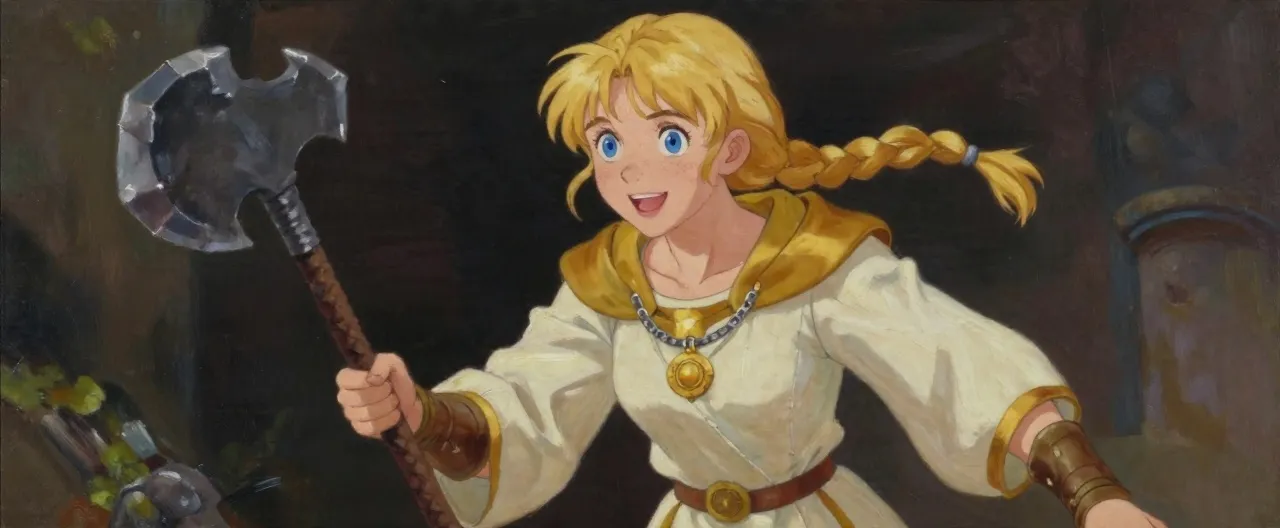
Sloane Fairbank was born in a river-country market town twenty miles from Eastwatch, the second child and only daughter of Aldous Fairbank, a stonemason who built wellheads and shrine steps and believed that honest work with the hands was the whole of a good life. Her mother died of marsh fever when Sloane was nine, and her father raised her with a kindness he showed better than he spoke it, and a stubbornness Sloane inherited whole.
At sixteen she was betrothed, by arrangement and in good faith, to a mason's son from two valleys over — a decent, dull boy she could not love and could not explain why she could not love. The betrothal feast was set for the week after the spring planting. That week, a Lathanderian mission came through the valley: two acolytes in cream and gold, setting a broken shrine-stone to rights and singing a dawn hymn badly enough that Sloane, hiding behind the well to listen, laughed out loud for the first time in a month.
One of the acolytes heard her and asked if she was all right, and Sloane — who had rehearsed a hundred polite refusals for the feast — heard herself say, 'I don't think I'm going to make it to Sunday.'
She ran to the temple at Eastwatch three days before her betrothal feast, and Sister Verane, the temple's steady, unglamorous prioress, took her in without asking a single question she wasn't ready to answer. For four years Sloane scrubbed the dawn flagstones, learned the Life domain's disciplines, memorized Lathander's liturgy of beginnings, and discovered — slowly, and then all at once — that what had begun as an escape had become a vocation.
She was good at healing. She was good at listening. She was, Sister Verane noted with some concern, entirely unsuited to the idea that some people cannot be reached, and so at twenty Sister Verane sent her south: walk the pilgrim road, learn what mercy costs on it, and come back with an answer that had road-dust on it.
The road answered faster than either of them expected. On her second night out of Valleyford she witnessed her first real violence at the broken milestone, froze at the worst moment, and a drover died while she fumbled her phylactery. She has built a careful story around that night — that he was beyond saving — and she tells it so well that she almost believes it. It is the stone under everything she has built since: the mercy, the hope, the notebook of spared enemies. If she is wrong about that night, she is wrong about the whole shape of her faith, and so she cannot afford to be.
Her doctrine is simple and exhausting to live: Lathander governs beginnings, and every person contains one. The Ashen Choir, when she learns of it, will pose the question her whole life has been rehearsing — a cult that bleeds people and calls it mercy, led by a woman who still prays to the dawn. Sloane's answer will not be simple. But she will give it, because she is the kind of person who answers.
She keeps a notebook of every enemy she has spared, sews grave-dirt into her robe's hem, carries an unsent letter to her father, and apologizes before she speaks — because the first thing she ever learned about the dawn is that it arrives apologizing for the night, every single morning, and never once stops coming.