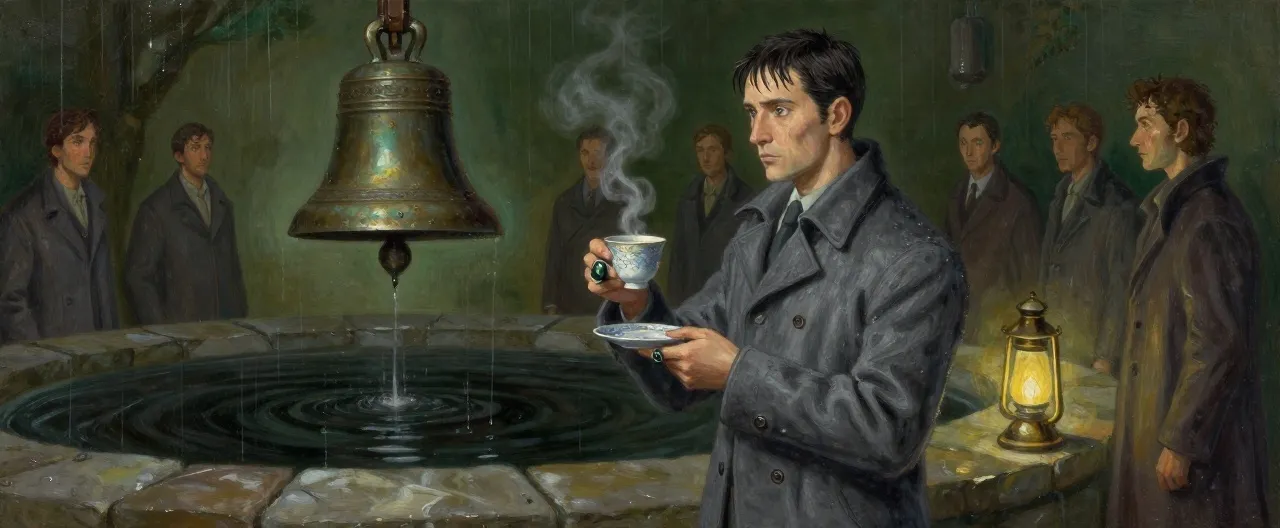
Maddock Vane was born in the village of Fenmoor, before the sea took the river mouth and the river took the fields — though he remembers it as a place of dry pasture, thatched roofs and his mother's small shrine to the Drowned Saint, and he remembers it drowning. He was in his late twenties when the marsh finally swallowed the last of it, and he was working the eel-sheds near the causeway when the water came up over the planks one night without wind or warning.
He drowned. He remembers the drowning with terrible clarity: the cold, the black, the bell note that came from everywhere and nowhere, and then — breath. He woke on the barrow's shore with a silver ring on his right hand that he had never owned, and a voice in the water that called itself the Bell-Keeper.
The voice made him a promise with the patience of the tide: drowned Fenmoor could be raised again — the village, the shrine, his family's graves — and it would cost voices. Not lives, the voice was careful to say. Voices. And Vane, who had lost everything to the water and been given back one thing only, believed it, because believing it was the only way the arithmetic of his survival made sense.
He has spent eleven years keeping that ledger. The first name in it was Orrin Sedge's silence, bought with a polite request and a shared flask. The first tithe was a grieving widow who wanted, more than anything, to stop hearing the marsh at night. Most of the taken went willingly. Vane is proud of this, in the quiet, damaged way a man is proud of never having had to raise his voice.
The Choir grew around him without ever being designed. A dozen villagers now stand in the barrow's pool or walk the roads as peat buyers, and they obey him not from fear but from the particular loyalty of people who were offered exactly the thing they could not refuse. Vane keeps no whip. He keeps a ledger, a teacup, and a set of manners polished so fine they function as armour.
Two drowned guardians rise from the pool when he bleeds, and nine taken stand waist-deep facing the bell — the current count, seven ringings deep, with Tam Ward among them, taken rather than recruited, the one entry Vane cannot make sit straight in the book.
What Vane does not know would unmake him. His own family name appears in the Sunken Chapel's wall records: the last bell-ringer of Fenmoor, a hundred years ago, was a Vane, and his ancestors hung the barrow bell to bind the water — to imprison the very thing that now speaks to him as a benefactor. The drowning of the Reach was not the sea's appetite; it was the binding straining, and the Bell-Keeper has spent a century recruiting the descendants of the people who chained it to do the unchaining. Vane believes he is raising his village. He is, name by name, ringing the bell that drowned it.
He has begun, very quietly, to notice the gaps. The Bell-Keeper has never shown its face. It speaks only through the bronze, never in the open air. The drowned wren he keeps as a familiar will not enter the passage behind the pool. The coins he pays in are a century old. He has filed each of these away as tests of faith, the way a careful man files away anything that might cost him everything to look at directly.
He is at the barrow now, on the dry step above the black pool, in his good grey coat, with tea steaming beside him and the eighth ringing scheduled — and when the party comes down the passage, he will turn around, greet every one of them by name, and mean every word of the offer he is about to make.