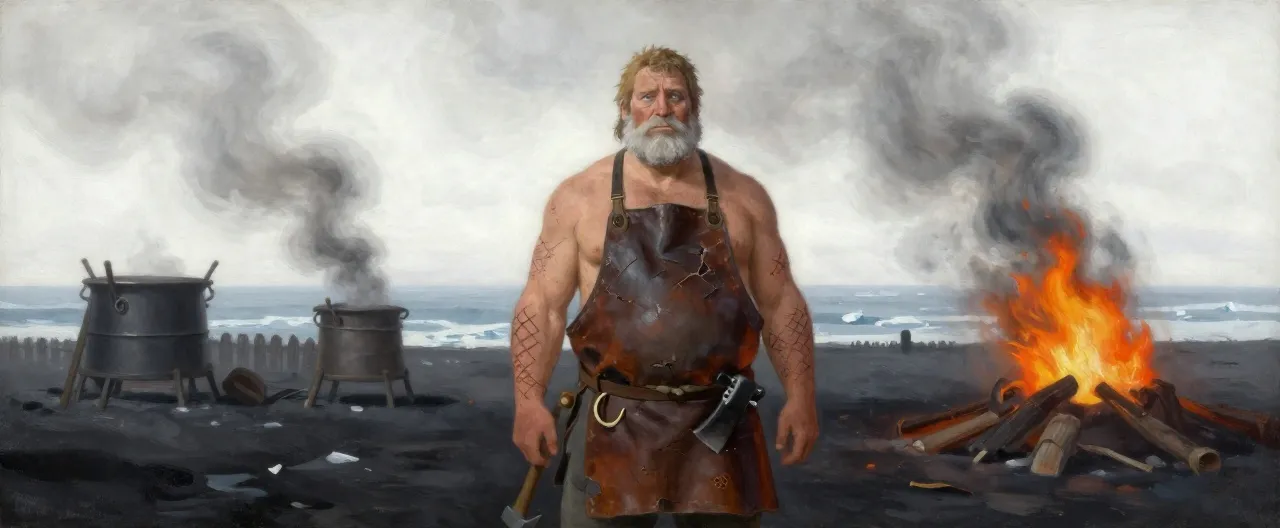
Sten Harrow was born in Greyharbor, the second son of a cooper, and went to sea at fourteen because there was nothing behind him and something ahead. He whaled the northern ice for twenty-two years — first as a boat-steerer, then as a harpooner, then as the man who ran the try-works, the fires and vats where blubber becomes oil. It is skilled, brutal, endless work, and it made him exactly what he is: patient with suffering, precise with schedules, and unafraid of fire.
He was good at it. Crews asked to sail with him. Captains gave him the camp's books because he never lost a barrel and never lost a man he could save.
He came to Frostmarch eleven years ago and never left; the camp was the farthest north a man could work and still be a man, and Sten liked the cold and the quiet and the honest arithmetic of whale-work. He had a younger brother, Joren, who followed him north two years later, and the two of them ran the try-works together through four seasons. Then, eleven months ago, the Ashvane Concord came: nine men in white coats, a banner, and a schedule.
They took Joren in the first week — not as a negotiation, just as a demonstration — and Sten found his brother's boots outside the rendering house, side by side, facing the sea.
What Sten did next is the whole of him. He did not fight. He did not flee. He sat down across a table from Sergeant Halloway and negotiated: eleven names a month, chosen by him, in exchange for rations, no arms in the camp, and the garrison's hands off the rest. He chose men who were sick, or alone, or already fog-touched — and then, as the months went on, he chose men who were troublesome, or strong enough to lead a revolt, and he told himself each time that it was arithmetic.
He kept count. One hundred and twenty-one. He recites them in his sleep, when he sleeps, and Vesna has heard him do it and never mentioned it. The camp does not know the full number. Grell suspects. The whalers follow him anyway, because the alternative to Sten's arithmetic is the garrison's, and because he stands the last watch every night and gives his own rations away on tithe days.
He has not slept properly since Joren's boots. The fog sings at the camp's edge every dusk, and it stopped reaching Sten about four months in — he walks the palisade through the singing untouched, which the whalers think is courage and Sten suspects is the fog deciding he is already spoken for. He has written his confession on treated hide and sewn it into his apron lining, and he checks the stitching every morning the way another man checks a compass.
He wants the garrison gone. He wants to be judged. He has wanted both for so long that they have become the same desire: an ending with a shape to it, a sentence with a number, anything but another month of the schedule. When the party walks into the blubber-yard, he will step out of the smoke and ask, low, the only question that matters to him: whether they have come to kill the garrison, and whether they will remember, afterward, what he did to help them do it.