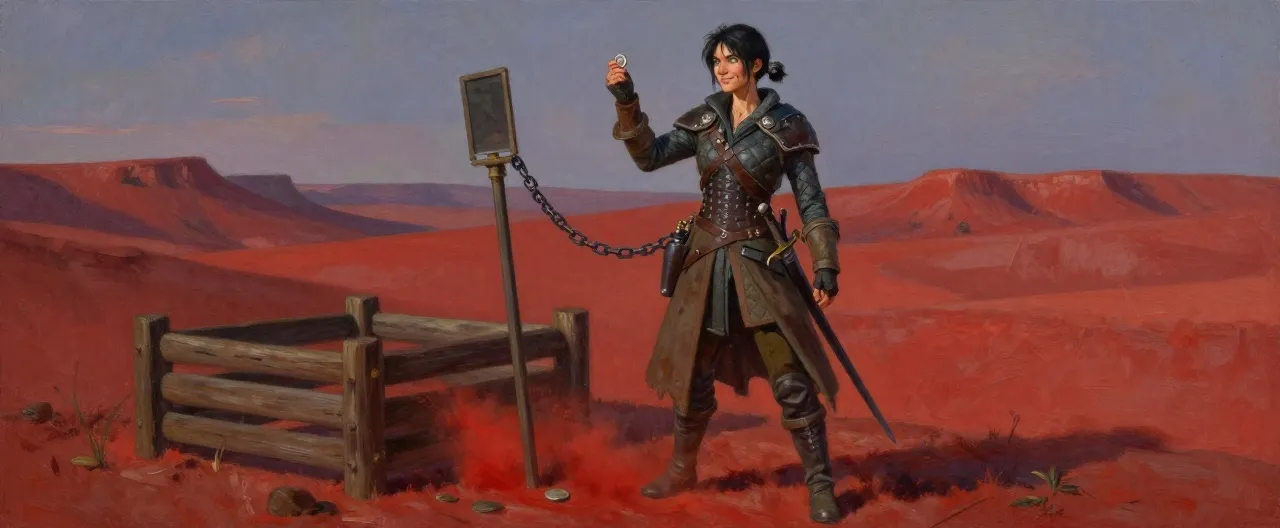
Maris Draper was born in a dry-season village east of Bitterbridge that no longer exists, the elder daughter of a well-digger named Draper who owed the Chain more than his well was worth. At fourteen she was sold to settle the debt — her father signed the paper himself, and she has read that paper since, in a toll-house, in his own careful hand. She spent two years as inventory in the Chain's salt camp on the far side of the badlands, where she learned the trade's true curriculum: not how to fight, but how to count.
What a person costs to hold. What a person brings at market. What a guard's silence goes for. What a crew boss's vanity is worth. She learned it so well that by fifteen she was correcting the camp's ledgers for the man who owned her, and by sixteen she had talked him into a commission structure instead of a purchase price.
She bought her freedom at seventeen the only way the arithmetic allowed: she sold eleven other people, named them in a document she signed without her hand shaking, and walked out of the camp with her own bill of sale folded in her pocket. She has never pretended it was anything but business, not to the priests, not to the Wardens, not to herself. She has also never forgotten a single name.
She keeps them on a folded page inside her cuirass, and she would tell you — if you asked, and if she liked you — that she keeps it for bookkeeping reasons, and her voice would do something on the word 'bookkeeping' that she would immediately charge you to forget.
She did not leave the trade. That is the part people get wrong about her; they expect a runaway's story, a girl who fled the salt and built something clean. Maris walked to the next toll post and talked the crew there into hiring her, because the Chain was the only organization on the road that paid on time, kept its contracts, and did not lie to itself about what it was.
In fifteen years she took it over — not with a knife, with margins. She standardized the toll, introduced receipts, moved the night-takers onto a rotation, and built the three-link chalk mark into a brand that toll crews from the Bitterwater to the deep desert respect. She keeps copies of forty years of Bitterbridge toll ledgers, listing every traveller who has passed the posts, because information is the one cargo that never spoils. She pays her people on time, hangs the ones who steal from the crews, and calls the whole thing a business because that is exactly what it is.
Her standing contract with the Ember Choir — eight silver a head, delivered alive — is the largest line in her books, and she signed it without asking what the singing was for, because asking changes the price. She finds the Choir embarrassing: their hymns, their ash sashes, their soft-handed preachers who talk about salvation while she does the hauling. She calls the whole arrangement a workplace hazard. But the Choir pays per head, on schedule, in silver, and that reliability is what her retirement plan is built on: a vineyard on the coast, a specific parcel, a specific price, written on the inside cover of her private ledger. She is eleven hundred gold short. Every captive is a step toward the coast.
Two things complicate the ledger. The first is Meera, her younger sister, who ran from the Chain two years ago and has been hiding as an acolyte at the shrine above Bitterbridge ever since. Maris has known where she is for two years. She has never gone up the hill, never told the Choir, and quietly rerouted her night-takers away from the shrine the entire time — the largest unpriced cost her ledgers have ever absorbed.
The second is Cedric Warren, the Lantern Warden-Captain on her payroll, through whom the Choir has been skimming her payments, a theft she has not yet discovered and which, when she does, will shake the road.
In the field she fights to escape, not to win: stinging dust, a guard between her and the blade, terrain, and terms. At half hit points she offers a bargain, and she honors any bargain she strikes exactly. Cornered, she surrenders and starts negotiating, because she is worth more alive than dead to the Chain, the Choir, the Wardens, and the villages alike — and because she has read enough ledgers to know that everyone on this road, given the right price, would have signed her bill of sale too. She is always faintly disappointed when they do.