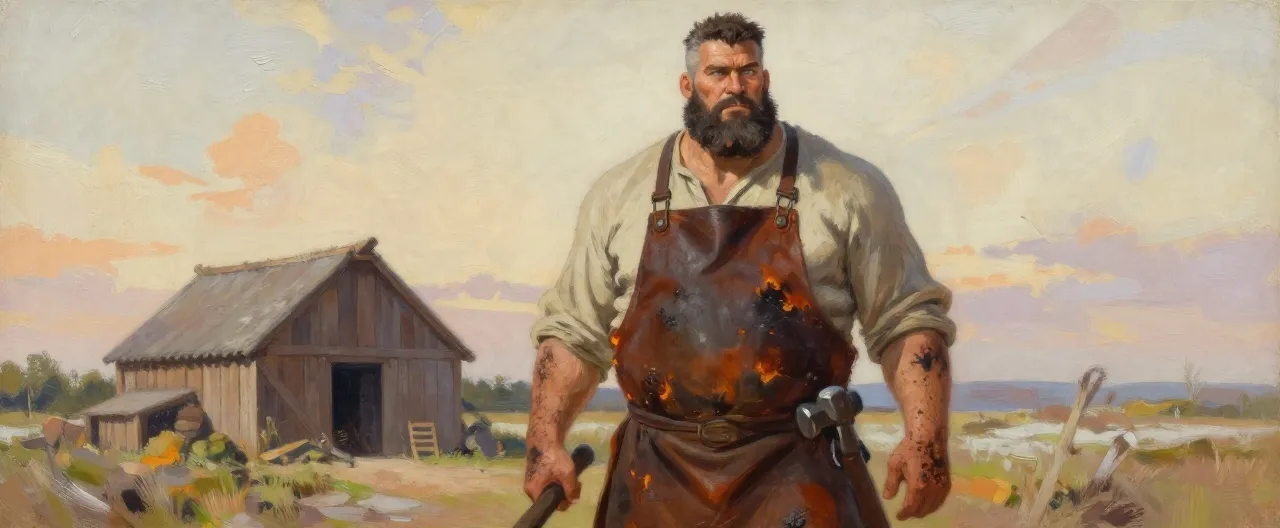
Oliver Stone was born in Weaver's Green and has never lived anywhere else, which he considers neither a limitation nor an achievement but simply a fact, like the grain of oak or the temper of good iron. His father was the village smith before him, and his grandfather before that, and the Stone family has kept the Weaver's Green forge for four generations — shoeing Covenant drovers' horses, mending loom-irons, and hammering out the plough-blades that keep forty houses fed in a country that gives nothing freely.
His father taught him the craft the way Covenant fathers teach everything: by silence, by example, and by a quench-song in an old dialect that Oliver still hums without knowing its origin. He was a large, slow, careful boy who broke things by accident until he learned to break them on purpose, and by sixteen he could lay a hammer-head that would outlast the haft twice over.
He married Maren Draper — no kin to Samuel Draper's line, whatever the village gossips decided — when he was twenty-four and she was twenty-two, a weaver with quick hands and a sharper tongue who matched him word for word and beat him at it. They had eleven years. She wove in the loom-house at the village's eastern edge, dyed her wool with salt-flower root the colour of old rust, and wrote him a letter every week he was away at the salt pans, and he kept every one.
The Kettle Chain came for her on a night in autumn three years ago, while Oliver was shoeing mules at the caravan yard in Valleyford, and by the time he got home there was a tally-stick nailed to the well board and an empty loom and a village that would not meet his eyes.
He went looking. He was gone nine weeks, and what he found at the end of the trail was a factor's mark in a book he was not allowed to read and a Chain camp he could not take alone. He came home quieter than he left, which the village had not thought possible, and he began to wait — mending armour, shoeing horses, refusing every coin, working the forge from before dawn until his hands stopped being his own. The village understood that grief looks like this in some men, and left him to it.
Two years later the Chain came back for the loom-house itself and burned it as a warning when the elders paid. Oliver stood in the road and watched it burn and did not move, because Maren's last letter — the one he had not yet found — would later tell him not to become a man who burns, and some part of him already knew the letter's contents. He has been waiting since. Not for grief to pass; for a reason.
The reason walked into the tithe-barn. When the Chain took Weaver's Green's young people two nights before the party arrives, Oliver was inside the barn with them — he had gone out to the north end at dusk to check the barn's hinges, as he does every night, and the collectors took him with the rest, manacled him with cold iron, and put him in the chain-line between the miller's boy and the well-keeper's daughter.
He broke the manacle with his hammer on the first night. He stayed three days, re-locking the shackle each night so the guards would not notice, because he could not free the others alone and would not leave them. When the party drops the barn's bar, Oliver Stone stands up off the straw, picks up his hammer, and fights beside them without a word — and afterward, in the yard, in the dusk, he says the first full sentence anyone in Weaver's Green has heard from him in three years: 'Which way did they go?'
He is a Battle Master in the only school that ever taught him: the school of the anvil, where timing is everything, where you read the material before you strike, and where a blow that lands wrong breaks the wrong thing. Trip Attack is how a smith fells a beast for shoeing. Precision Attack is a hammer striking the exact spot on a blade. Riposte is the counter-rhythm every hammerman learns before he learns anything else. His Aspect of the Forge — the endurance of a man who has stood in furnace-heat for twenty years — is not magic to him. It is simply what he is made of.
He will follow the party to the end of the road, repair their armour every night for free, and never ask them for anything except to be pointed at the right man. He carries a list of eleven names scratched under his anvil's belly, a loom-weight carved with a sun older than the Covenant, and a letter he has read so many times the folds are wearing through. He is lawful good the way bedrock is lawful good: not because he follows rules, but because he is what he is, all the way down, and Maren married that man and would recognise him still.