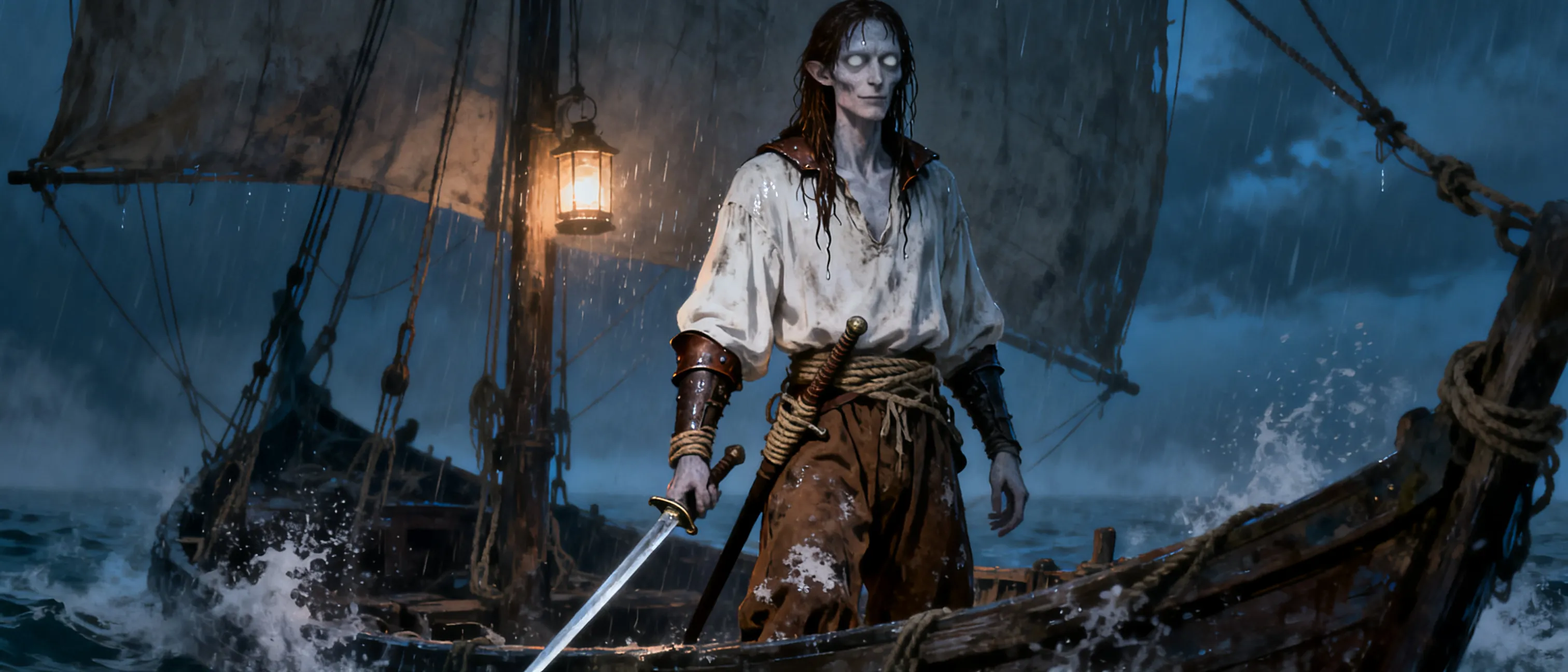
Varin Brovelart does not know who he is. The first thing he remembers is darkness — cold, crushing darkness — and then light, gasping air he did not need, tangled in a fishing net aboard a trawler whose crew screamed at the sight of him. They had hauled in what they believed was a corpse: a pale, gaunt man with clouded eyes and hair slick with seawater, cold to the touch. When he opened his eyes and sat up, the fishermen nearly threw him back overboard. He does not blame them. He is not entirely certain they were wrong about what he is.
He had no name, no memories, no possessions — only instinct. His hands knew knots. His feet knew the roll of a deck. His body knew the rhythm of the sea as though he had been born aboard a ship. So he stayed with the fishing vessel, working the nets and rigging, watching the crew who tolerated him with a mixture of fear and pity, and piecing together whatever identity he could.
He took his first name, Varin, from the ship's captain — the only soul aboard who treated him as a man rather than a bad omen. His surname, Brovelart, he invented himself, because a man without a name is a man without a place, and he refused to remain unplaced.
Whatever life came before the net is lost to him. He knows only that it left marks: a duelist's discipline in his sword arm, a sailor's knowledge in his bones, a whisper of Fey blood in a lineage he cannot trace, and a body that does not breathe, does not hunger, and does not easily die. Sometimes, in quiet moments or moments of need, fragments surface — a knot tied a certain way, a word in a dead language, the smell of a harbor he cannot name. He collects these fragments like a man collecting pieces of a broken mirror, hoping the whole image will eventually appear.
Then came the storm. It was a deadly one, the kind sailors whisper about and do not name, and it took everything: the masts, the hull, and every living soul aboard the ship. Every soul but one. Varin did not drown, because Varin cannot drown. He walked the wreckage and the waves alone, wandering the open ocean for days that felt like years, passing drowned sailors who no longer needed rescue, until at last he found refuge with the player party's vessel — and, in time, with the party itself.
He carries quiet grief for the crew he could not save, and quieter dread at the question he cannot answer: why did the sea take everyone but him? He does not know whether he was a sailor, a soldier, a duelist, or something worse in his first life. He does not know whether his undeath is a curse, a punishment, or an accident. What he knows is who he chooses to be now: a man who fights fair with a rapier, who pulls his weight on any deck he stands upon, who is friendly even when people flinch at his face, and who follows a code of honor because it is the only possession that survived his drowning alongside his body. He is quiet, watchful, and gently kind — a dead man's body carrying a living man's decency, sailing toward whatever truth the sea will finally give up.