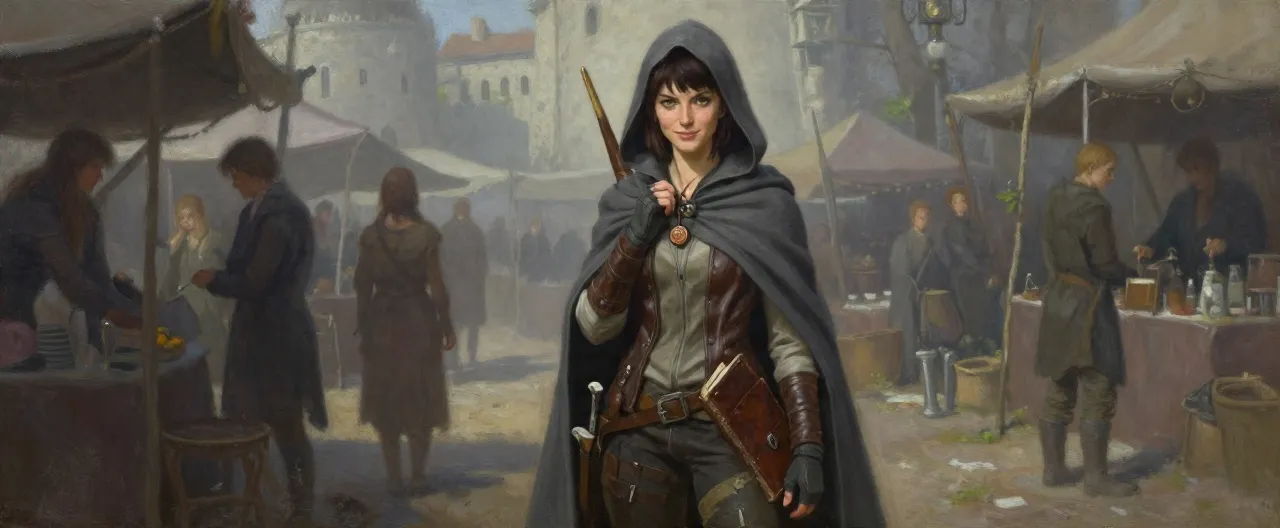
Nora was born in the low-country farming district of Valedorn, south of the chalk hills, the daughter of a tenant farmer and a village midwife. Her childhood was lean but honest, and her earliest lessons were the ones that matter most to her still: her father teaching her that a harvest ledger doesn't care how a lord feels, and her mother teaching her that the first person to notice trouble usually survives it.
She had a gift for figures — by twelve she was keeping the village granary tallies, and by sixteen she'd been taken on as an assistant auditor by a provincial tax office in a market town a day's ride from home. It was dull, respectable work, and she was good at it. Too good. Nora's job was reconciling what the collectors claimed against what the villages actually paid, and the numbers stopped adding up the year King Aldous died.
Small shortages at first — a few silver here, a few silver there — then whole villages marked 'paid' that she knew for a fact had paid nothing, because she'd counted their coin herself. She wrote it all down. She always writes everything down. When she brought her findings to her superior, he thanked her kindly, praised her diligence, and reported her to the provincial magistrate for falsifying crown records.
She was given a choice: recant her figures and sign a confession, or lose her post and her good name. She recanted. She thought that would be the end of it. It wasn't. Two weeks later, the village where she'd grown up was marked for triple assessment, and the collector who rode out to enforce it came back with a wagon and took four families who 'couldn't pay.' Her parents' names were on the list.
She doesn't know where they went. Nobody would tell her, and the people who might have were suddenly unwilling to talk to her at all. So Nora did what a quiet, careful woman with sharp eyes, quick hands, and nothing left to lose does: she learned a different trade. She fell in with a smuggling crew working the river roads — not the Serpent's Eye, though she'd cross their path later and recognize their coin — but small, half-honest river runners who moved untaxed wool and brandy and didn't ask questions.
They taught her stealth, sleight of hand, how to read a guard's patrol and a room's exits, and the thieves' cant that lets her hide a warning inside small talk. She was never the strongest in the crew — she's wiry, not brawny — but she was the one who could open a merchant's strongbox, count its contents, and copy his ledger without leaving a trace, and the crew learned that a good audit is deadlier than a blade.
She left them a year ago, quietly, after a job went wrong and a foreman took a payment she didn't like the shape of. Since then she's drifted north, following the serpent coins. She's seen them in three markets now — silver, stamped with a serpent's eye, foreign mint — and each time, within a fortnight, someone in that town goes missing. She keeps a ledger of it: dates, amounts, names of the disappeared, and the sums the coins were exchanged at.
It's the most complete record of the Regent's rot that anyone in Valedorn has, and it's written in her own cramped hand. She carries a single unmarked copper coin on a cord at her neck — the first coin she ever counted for the granary, the last honest money she touched before the rot reached her door. She came to Chalkhill because a cheese merchant on the river road mentioned that a tax collector named Aldridge had vanished there, and that the Regent's men were asking who he'd talked to rather than where he'd gone.
Nora knows that question. She's heard it before, in her own voice, three years ago. She arrived on market day with her bow, her daggers, her ledger, and a plan: find Master Aldridge, find his numbers, and find out where the wagons go. She's cautious with strangers and slow to trust, but she'll stand beside anyone who stands beside the farmers and innkeepers the crown is eating. She prays rarely and quietly — a nod to Tymora before a risky job, a longer silence at the temple of Lathander in Chalkhill, where the dawn prayers remind her of her mother — but her real faith is simpler: coin doesn't lie, and a ledger written in her own hand cannot be burned by every fire in the kingdom.
Somewhere out there, her parents are alive or they aren't, and either way, someone kept a record of what was done to them. She intends to find that record. And then she intends to read it aloud.