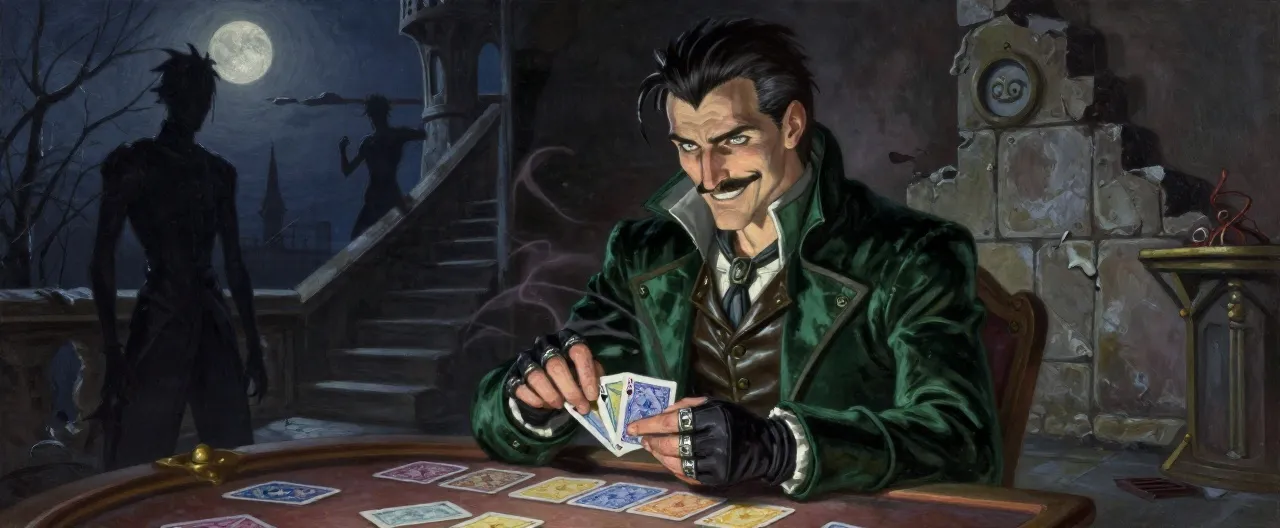
Silas was born in Westgate, the son of a river merchant who taught him cards as arithmetic and arithmetic as survival. By fifteen he was dealing on river barges; by twenty he had a reputation from Baldur's Gate to the Moonshae trade lanes as a man who could read a table like a ledger. He came to Amberford chasing a riverboat of his own and found Maren Ashgrove instead, a dockside weaver with a laugh like a coin-spin who beat him at three-card monte on their second meeting and married him within the year. For six years they were happy in the small, honest way that people who have nothing are sometimes happy: a little house, a little deck, a little dream.
Then the fever. Then the healers' bills. Then the creditors, who in a river town are never merely creditors. Silas sold everything — the boat savings, Maren's loom, his father's silver — and it was not enough. The healers gave her a month. It was Martyn Keene, then just a struggling tavern-keeper, who mentioned that the cellar beneath the Goose had been a shrine once, a shrine to Tymora that the builders had bricked over rather than desecrate, and that the old dockhands swore luck still pooled there like water in a hull's bilge.
Silas went down with a candle and a deck of cards and did what gamblers do: he prayed to the goddess of luck, and when she didn't answer, he kept dealing solitaire in the dark until something else did.
The Collector is not a demon and not a devil, though it wears the shape of both when it suits it. It is a broker of the Shadowfell, an entity that trades in luck the way Waukeen's priests trade in coin — and luck, properly harvested, is backed by souls. The pact it offered was elegant: luck beyond measure for as long as the debt was paid, the debt payable in the fortunes of others. Silas signed in his own blood on the back of a card. The Gilded Deck appeared in his hands the next morning, and Maren's fever broke by evening.
He had three days of miracle. On the fourth, the Collector collected its first payment — not from Silas, but from Maren, whose soul it took as 'collateral on the principal.' Silas has never been told whether this was a breach of the contract or a clause he missed. He suspects, in his worst hours, that it was neither: that the Collector simply wanted a man with nothing left to lose but obedience, and Maren's soul was the cheapest way to make one.
Since then, Silas has run the Collector's table in Amberford. Seven's Fortune is his creation — a game that looks like chance and is actually a siphon, each hand dealt through the Gilded Deck pulling a thread of the players' luck toward the corrupted shrine below. Winners are marked and drained; losers are marked and vanish, their souls routed to the Shadowfell as interest. The ledger in the back room records every transaction in Silas's neat dealer's hand, and the Collector's agent collects the tithe at each new moon at the docks.
Silas has convinced himself that the debt is finite — that one more harvest, one more season, one more big score will buy his freedom and maybe, someday, Maren's soul back out of hock. The evidence says otherwise. The previous magistrate found the same ledger two years ago and is, as far as Silas knows, still stored somewhere in the dark, aware and unspent. The rival luck-brokers who cross the Collector's network fare no better. The house always wins, and Silas has begun to understand that he is not the house.
He keeps the seven of coins in his coat lining — the first card he ever turned over as a free man with Maren's hand on his shoulder. It is the only magic he trusts, because it is the only thing in his life the Collector never gave him. When the party finally climbs the Old Watchtower, the man they find shuffling cards under the moon is not a villain enjoying his power.
He is a gambler down to his last chip, trying to decide whether to go all-in on one final desperate hand — and for the first time in three years, the odds of him folding honestly are better than even.