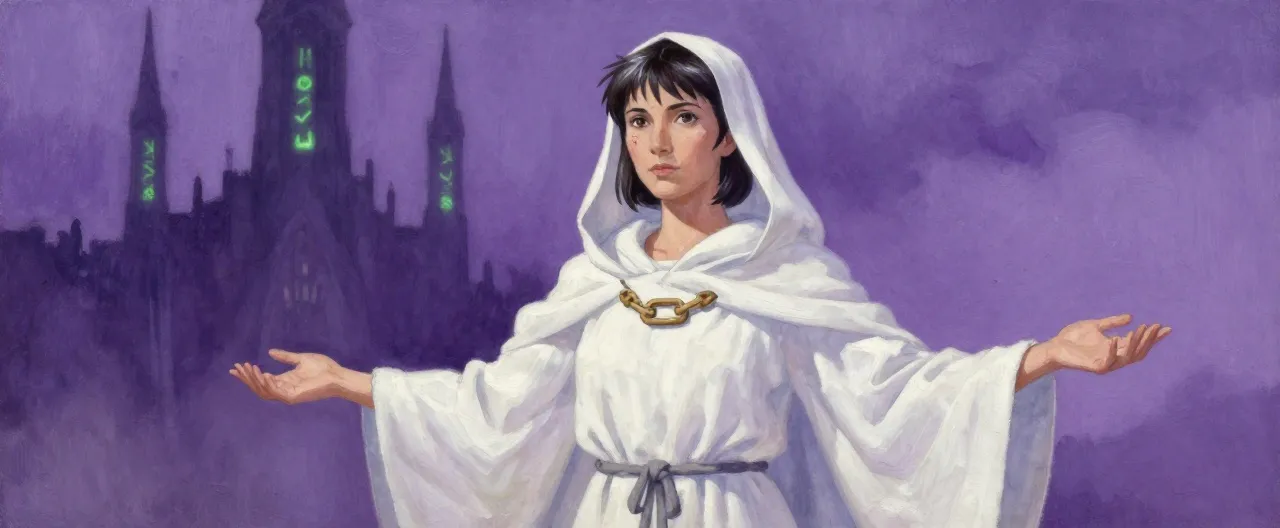
Sora arrived in the Bastion five years before the players, processed like any other inmate: stripped, numbered, and thrown before the Warden's illusions in the Trial Chamber. What the illusion showed her, she has never told anyone—not the Penitent elders who took her in, not Rusk, whom she healed against doctrine, and not the players, though fragments surface in her rare unguarded moments. What is known is that she emerged from her First Trial changed: where others broke or raged, she knelt in the green fire's light and wept, and when she rose, she began to pray to a god whose name no one in the Zone remembered.
The prayers were answered. Whether her magic comes from a real divine connection or from the Zone itself—Aethel's chained presence bleeding through the walls—she cannot say, and the question terrifies her.
Before the Bastion, Sora was an acolyte of a small temple order on the material plane, a healer and midwife beloved in her district. Her conviction—mercy-killing, the courts called it murder—stemmed from her husband's long illness and his desperate, repeated pleas. She has never denied to herself that she did it, only that her sentence was just, and this distinction is the engine of her entire philosophy: guilt can be real even when punishment is a lie, and the Warden's great crime is that he harvests the former while manufacturing the latter.
In the years since, she has built something unprecedented in the Bastion: a faction that holds power without violence. The Penitents number perhaps forty, white-robed and disciplined, sheltering the broken and confronting the guilty. She leads their dawn vigils, decides which new arrivals they will shelter, and has personally talked down three yard riots by simply walking into the middle of them. Her authority is moral, not coercive—she commands no enforcers, only devotion—and this makes her both indispensable and fragile. The splinter group under Mira follows her example rather than her orders, and their drift toward a mass-suicide 'release ritual' is the wound in her faction she cannot heal alone.
Her alliance with Rusk the Breaker is the Bastion's oddest friendship: the healer who broke doctrine to save him, and the brawler who has never forgiven the system that made him. They trade intelligence through a dead-drop in the mess hall, and between them they hold the two halves of the prison's greatest secret—she knows the tunnels exist and that the Warden was once a prisoner himself; he carries the map fragment that proves it. When the breaking comes, the Penitents and Breakers will need each other, and both know it.
Her enemies are few but sharp. Vex the Collaborator stole her locket—her daughter Lira's portrait, and the hidden message inside it—and wears her suffering like a trophy, taunting her with it in the yard. Sora has never struck him, and her restraint is itself a penance and a statement. More dangerous is Shadowtongue, the Archive's spymaster, who has quietly opened a crystal record on her. Most dangerous of all is the Warden's voice, which has begun calling her 'sister' during trials—a familiarity suggesting Malakar knew her before the Bastion, or before it was a prison at all.
And in her dreams, Aethel's Echo whispers that she is 'the last priest,' calling her toward the tunnels where the runes name her crime in a verse she has read only once, alone, and never repeated.
She carries three things close to her heart: the whole-chain symbol of Aethel, the memory of her daughter's face, and the hope—reckless, perhaps—that even Malakar can be forgiven. Everything she does in the campaign flows from these three anchors, and every choice the players make around her will test at least one of them.