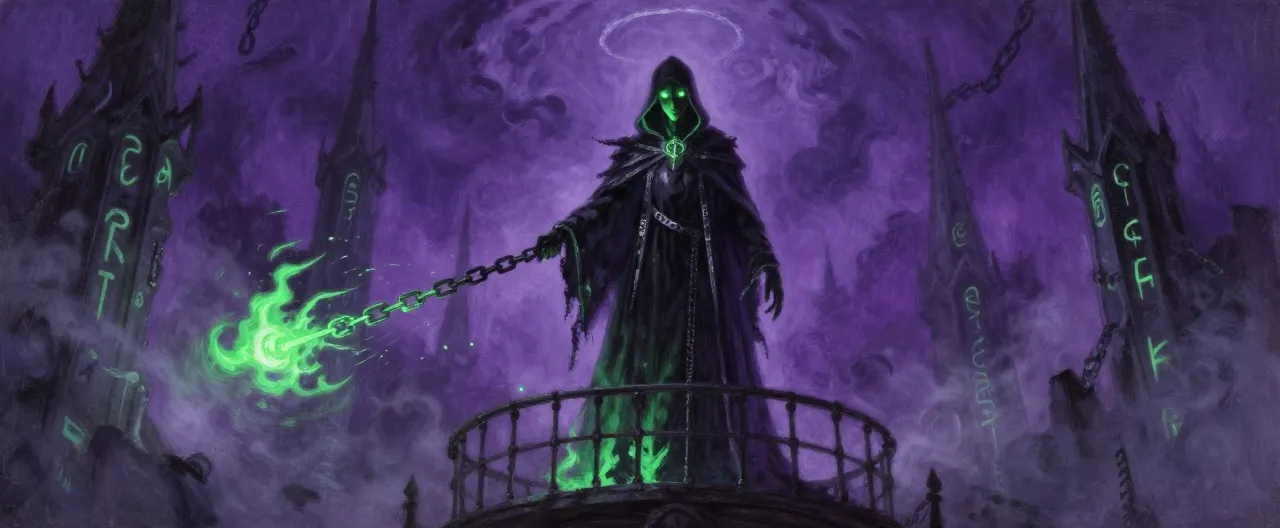
Malakar was born a mortal man in a kingdom that has since crumbled to dust, the son of a stonemason and a temple laundress, raised in the shadow of a great cathedral dedicated to Aethel, the god of chains. Aethel's faith was strange and severe: the god taught that every soul forges its own bindings through wrongdoing, and that penance—voluntary, honest, endured—was the only tool that could break them. The church of Aethel ran sanctuaries where the guilty came freely to serve sentences of their own confession, and young Malakar, brilliant and hungry, rose faster through its ranks than any priest in a generation. By thirty he was high priest, keeper of the deepest sanctuary, confessor to kings.
He was also, by then, already lying. The sanctuary's penitents confessed to him daily, and Malakar discovered early that he could feel their guilt—a warmth, a nourishment, a quieting of something hollow in him. He told himself it was the god's grace flowing through him. It was not. It was an aptitude the faith had no name for, and it grew with every confession he drank.
The catastrophe came in his fortieth year. A plague swept the kingdom, and the sanctuary filled beyond capacity. Malakar worked himself hollow feeding on penitent guilt to keep the dying calm, and in his exhaustion he did the unthinkable: he asked Aethel, directly, why a god of mercy would let the innocent suffer. The god's answer—that suffering was the chain, and mercy the file that freed it—struck Malakar as monstrous. In his darkest hour he decided the god himself was the prison: that Aethel's doctrine of endless penance was a divine cruelty, and that someone must bind the binder.
He prepared for years. He learned the rites of binding from the inside, stole fragments of starmetal from Aethel's own chain relics, and on the night of the god's high holy day, he turned the sanctuary's greatest ritual against its own deity. Aethel did not fight him. That is the detail that haunts Malakar most: the god of chains let himself be chained, watching his friend and finest priest with something that was not anger.
Malakar took the god's heart—an orb of pure light—and with it, the power to build. He inverted the sanctuary: a place of voluntary penance became a prison of forced guilt, and the demiplane he raised around it became the Phantom Zone, with the stolen heart as its Core and its phylactery.
He told himself it was justice. He has been telling himself that for centuries. The Zone grew: iron rings, cell blocks, a Trial Chamber, golems of chain and shadow, and an archive recording every sin. Malakar ruled as its Warden, feeding on the guilt of the multiverse's condemned, and discovered the terrible arithmetic of his condition—guilt sustains him, but only fresh, true guilt. Fabricated conviction, coerced confession, and innocent suffering all produce counterfeit guilt that nourishes him less each century.
So he began framing the innocent, convinced that their eventual false guilt would ripen into the real thing. It does not. It sours. And the tremors in the Zone's foundations are the sound of a god's heart, beating slower, waiting for its thief to remember what he did.
Malakar's fifteen-day ritual is real: with enough harvested guilt, he can tear a passage to the material plane and walk free of his own prison, leaving Aethel bound and the Zone to collapse. But the Archive record he has never read says otherwise—it says the ritual's true final component is not guilt but forgiveness, freely given by someone who knows his crime. Malakar does not know this. He does not know that his escape and his redemption are the same door, and that the only question is which face he wears when he walks through it.