Call the Herald (Custom)
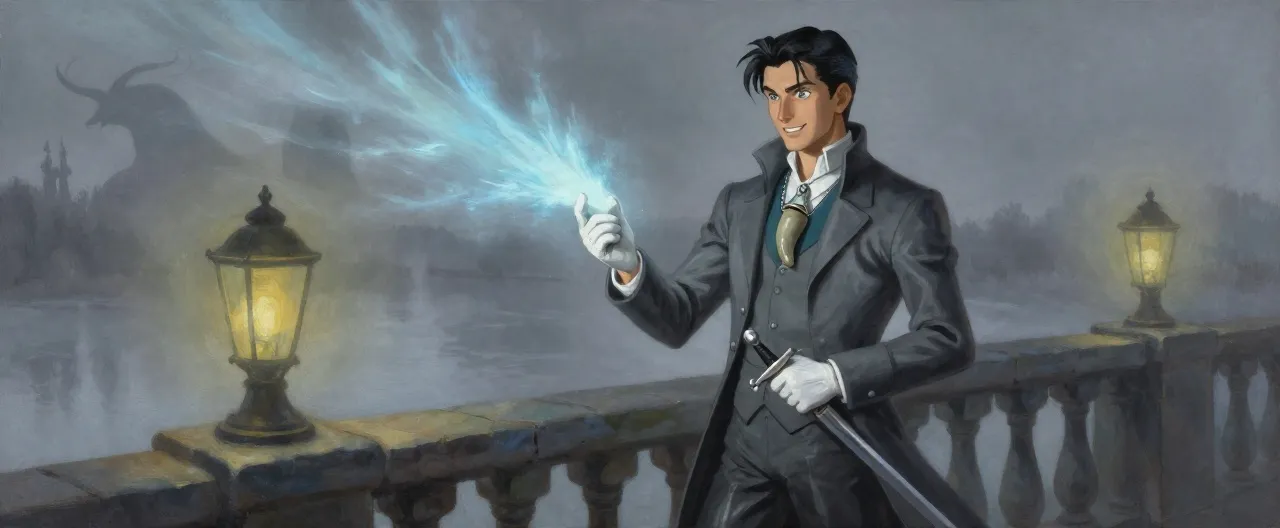
At half hit points, Grant blows a small horn carved of river-stone. The horned hound arrives 1d4 rounds later, scatters the party, and Grant escapes in the confusion. He cannot fully control the hound and fears it.
This character will be deleted in 6 days. Create a free account to claim all your generated content.
At half hit points, Grant blows a small horn carved of river-stone. The horned hound arrives 1d4 rounds later, scatters the party, and Grant escapes in the confusion. He cannot fully control the hound and fears it.
Throws a clay pellet that bursts into a 10-foot-radius cloud of grey smoke (heavily obscured) for 1 minute, or until dispersed by moderate wind. He carries 3. Used to open fights and cover escapes.
If Grant is killed, his body dissolves into river-water and his letter of credit is found blank — the Buyer erases its agents. This is a story trigger, not a combat mechanic.
Once per turn, deal an extra 2d6 damage to a creature you have Advantage on an attack roll against, or where an ally is within 5 feet of the target.
Climb at full speed. Gains a Jump distance bonus. Lets him use bridge rails, mine ladders and flooded stairs to stay out of reach.
Use Sleight of Hand, pick locks, disarm traps, or stow/draw items with a Bonus Action — including using his custom smoke bombs.
Add proficiency bonus to Initiative; may swap Initiative with a willing ally. Explains his knack for 'arriving first'.
Take the Dash, Disengage, or Hide action as a Bonus Action each turn.
Doubles proficiency bonus with Deception and Persuasion.
Knows Thieves' Cant and can leave coded messages.
Mastery of Daggers (Nick) and Shortbow (Vex).
Behind the character
Grant Haywood is a tall, immaculate man in his late thirties with neat black hair combed straight back, sharp grey eyes, and a thin, courteous smile that never quite reaches them. He wears a fine slate-grey coat over a river-grey waistcoat, polished half-boots spotless despite the mud of the Reach, and white gloves he removes only to handle shards — folding the glove with small ceremony, as if the shard should feel honored. He smells faintly of bergamot and, beneath it, of river-water, a scent the party will learn to dread before they learn its source.
He is soft-spoken, unfailingly courteous, and genuinely delighted by good work — he compliments the party sincerely, remembers every name, and tips innkeepers generously, which makes him hard to hate and harder to trust. He lies by omission and by asking questions rather than making claims: 'And where would you be keeping that lovely shard, if I might ask?' His voice is low, measured, and warm, with a Waterdhavian accent, and he never raises it — not mid-negotiation, not mid-swordfight.
When cornered, he becomes eerily calm and begins speaking about 'the arithmetic of it', weighing lives like coin in a ledger only he can read. He keeps his back to exits, a rail or ladder within reach, and never gloats until the very end — and even then, he apologizes first.
Beneath the polish is a boy sold with his father's debts, an aunt he cannot face, and a patron whose letters smell of the same river that took his father. He believes the Waystone is a lock, not a door, and that turning it will be a historic transaction — one he intends to attend from a seat at the table, if the table will have him.
Before the adventure
Grant Haywood was born in Riverwatch, the son of a ferryman who worked the Silver River crossing before the Tollbridge made the ferry obsolete. When the flood came and the lower town drowned, his father's name went into the water with the choir's future congregation, and the family's debts went to a Waterdhavian counting-house. Grant, nineteen, signed himself in with the debts — a legal instrument he did not fully read and has never stopped reading since. The first letter from the Quiet Buyer arrived within the week: bergamot-scented, unsigned, and impossible to refuse. He has been the Buyer's Hand for six years.
The work suits him. Grant discovered early that he lacks the stomach for violence and the talent for it in equal measure, but he has a flawless memory for names, debts, and faces, and a manner that opens doors muscle never could. He worked collections first, then appraisals, then acquisitions — the polite word the network uses for theft — and he became very good at arriving first: at the auction before the auction, the estate before the heirs, the ruins before the scholars. The Alert instinct that makes him hard to surprise in a fight is the same instinct that made him rich in his trade.
Two months ago, the counting-house sent him to the Reach to catalogue the Tollbridge for Lancel Winfield. It was meant to be routine. Then he found the bridge-keeper's ledger, and the page listing five shard-holders across five planes, and understood that the Waystone was not a bridge-key at all. He copied the page, was dismissed by Winfield for prying, and took what he knew to the Buyer — the transaction that turned a collector's catalogue into a campaign. The Buyer's response was the horn: a small river-stone horn on a silver chain, and the enormous thing that answers it.
He does not fully control the hound. In the beginning he told himself it was a servant, lent like a mule cart or a letter of credit. Since the mine — since the one time he blew the horn and what answered was not entirely the hound — he has begun to suspect it is a leash, and that the hand holding it is not his. He hires bandits to do the breaking, spores and stolen stones to do the damage, and forged pages to do the lying, and he keeps his own gloves immaculate throughout.
It is not squeamishness. It is bookkeeping: he believes that a man who keeps his hands clean keeps his options open, and options are the only currency the Buyer cannot print.
His connection to Ruth Haywood is the loose thread in an otherwise tailored coat. She is his great-aunt, the last of the family that sold him, and she holds the fire-shard without knowing her sister's boy is the shiny man who opened the vent above her seam. He has sent bandits rather than go himself. He tells himself it is efficiency. He knows it is cowardice, and he files that knowledge where he files all his debts.
He genuinely believes the Waystone is a lock — that something on the other side has been waiting three generations for the tumblers to line up, and that opening it will be a historic transaction. He wants a seat at that table the way a poor man wants land: not from greed, exactly, but from the terror of being outside it. And so he herds the party toward the shards with courtesy and smoke, apologizes in advance for what he will take from them, and practices, in empty rooms, the speech he will give when he finally has all five and no longer needs to be polite at all.
Threads to follow
Beneath the surface
What haunts them
What drives them
Personal quest · 1
Grant hires a Waterdhavian scribe to forge a replacement page of the bridge-keeper's ledger — one that names different shard-holders — and asks the party to 'verify' it against their own findings. If the party compares the forged page with the real half-burned one in the bridge-keeper's cottage, they catch the discrepancy, and Grant's web of polite half-truths begins to unravel. Grant's goal is to redirect the party away from the shard-holder he hasn't reached yet while appearing to help them.
Grant presents the forged page over drinks at the Bridge & Bell, thanking the party profusely for their 'indispensable work'.
Personal quest · 2
Ruth Haywood, the ash-miner elder, is Grant's great-aunt and does not know what he has become. Grant needs her fire-shard, but he cannot bring himself to face her — the last piece of the family he abandoned when the Quiet Buyer's letter of credit bought his debts. He attempts to have his bandits steal the shard rather than ask her for it, and the theft goes wrong, worsening the mine's venting and poisoning three more miners. The party can arrive during the botched theft, after it, or be hired by Grant himself to 'recover a family heirloom' — a lie wrapped in a truth.
Grant's bandits break into the deep seam at night; the vent is knocked open in the struggle and Ruth collapses from ash-sickness.
Personal quest · 3
Grant is lent the horned hound, but he cannot control it — and lately it has stopped obeying his horn. It stands at the edge of his camps at night, watching him the way it watches the party, and Grant has begun to suspect the Buyer lent it not as a servant but as a leash. He quietly commissions the party — through an intermediary, under a false name — to 'follow the big dog and see where it goes when nobody's looking.' He is hiring his own enemies to spy on his own master, because he is afraid of the answer.
A sealed letter of credit arrives at the Bridge & Bell offering 75 gp to track 'the Barge' and report to a drop-spot under the ferry stairs.
At the Flooded Cellars, Grant has three shards within reach but the drowned choir's song is waking something in the water below — something even the hound will not look at. He can take the shards and run, or stay and watch what rises.
If he stays, he witnesses the thing beneath the bridge and his certainty that the Waystone is 'a lock, not a door' hardens into religious conviction — he gains the Resolve of the Witness trait (Advantage vs. Fear, but he can no longer be talked into turning against the Buyer without proof of the thing beneath). If he runs, his nerve is shown to be arithmetic after all, and the DC to turn him at the act's end drops to 15.
Ruth Haywood, dying of ash-sickness after his bandits' botched theft, asks the shiny man — not knowing it is him — to sit with her a while, the way family used to.
If he sits, Ruth's words plant the seed of his possible redemption: he gains the trait 'Aunt's Blessing' — once per campaign, when he would be reduced to 0 hit points, he instead stabilizes at 1 hp, and he can no longer bring himself to target Ruth or anyone protecting her. If he walks away, he hardens: he gains a permanent +1 to Deception (the mask fully sets) but permanently loses the ability to surrender — he now fights to the death if cornered.
Cornered at the act's climax with the party holding evidence of the counting-house watermark, Grant offers his surrender and information — some of it true. The party must decide what to do with the man the Buyer will erase anyway.
Kill him: his body dissolves into river-water, the letter of credit is found blank, and the Buyer marks the party for a herald's attention in Act II. Turn him: Grant becomes a double agent, feeding the party the Buyer's delivery schedule, and his smoke bombs and Fast Hands become party-usable tools. Let him go: he delivers two shards to the Buyer, strengthening the act II antagonist, but he leaves behind the forged ledger page — a thread of guilt the party can pull later.
The party exposes the forged ledger page to his face
Grant stops asking questions and starts answering them — the first honest conversation he has in the module, and the moment his charm becomes a liability instead of a weapon.
He hears the drowned choir's song slowed to the Waystone's rhythm
Grant realizes the shards are not treasure but tumblers, and that whoever turns the lock becomes its keeper — a job with no exit. His 'place at the table' fantasy dies quietly.
Ruth calls him 'my sister's boy' without knowing who he is
The last name he was proud of becomes the one thing the Buyer's river-water cannot wash off him.
Ally
Grant kept a room at the Bridge & Bell for a full week before the Waystone shattered, and Roslin liked him — he tipped like a lord, complimented her mutton pies, and remembered her daughter's name. He came and went at odd hours, and she assumed a collector's business kept strange time. When he left, he overpaid his bill and told her to keep the room 'for when I pass through again', which she took as kindness.
She still has his room key on a hook behind the bar and mentions him fondly to travellers, describing the polite man in the good coat to anyone who asks — which is how the party first hears of him. Grant, for his part, counts Roslin among his assets without her knowing: her guest ledger, her gossip, and her habit of telling everyone the hound is a barge all serve him.
He has never lied to her directly, which he considers a point of professional pride, and if the party turns her ledger against him he will be genuinely, briefly hurt.
Enemy
Lancel hired Grant two months ago to catalogue the Tollbridge's planar crossings and dismissed him within the fortnight for 'prying past the commission' — in truth, Grant had found the ledger page and copied it before Lancel even knew it existed. Lancel's forty-year career has been built on buying things no one else can reach, and Grant was the first person to reach past him, which the old collector neither forgives nor forgets.
Worse, Lancel suspects — correctly — that Grant's dismissal was the moment Grant went to the Buyer with everything he'd learned. The two men speak the same language of provenance and price, which makes the hatred precise rather than hot. Grant, for his part, considers Lancel a dilettante who collects the planes the way other men collect snuffboxes, and genuinely believes the shards belong with someone who will use them. If Lancel is ever given proof of Grant's treachery, he will spend his own fortune hunting the man who made him look like a fool in his own library.
Faction
Grant is not a member so much as an instrument — the Buyer's Hand, a title he is proud of and increasingly frightened of. The network reaches him through a Waterdhavian counting-house whose letters of credit no one in the Reach can verify, through the horned hound he cannot command, and through the blank page at the end of every contract: agents who die are erased, their papers found blank, their bodies given back to the river.
Grant has served the network for six years, long enough to know its methods and never once its face. His standing is high — he delivered the bridge-keeper's ledger page, he coerced Osha Millstone's cooperation through intermediaries, and he is closing on the five shards — but the hound's recent disobedience has made him wonder whether standing in the Buyer's ledger is the same as being owned by it. Every favor he does the network buys him a little less freedom, and he knows the arithmetic of that better than anyone.
Join thousands of players and create rich, detailed character backgrounds with Fable Fiesta!
Register to unlock personal quests, relationships, and narrative hooks!
Sign Up Now - It's Free!No credit card required. Start creating in minutes!