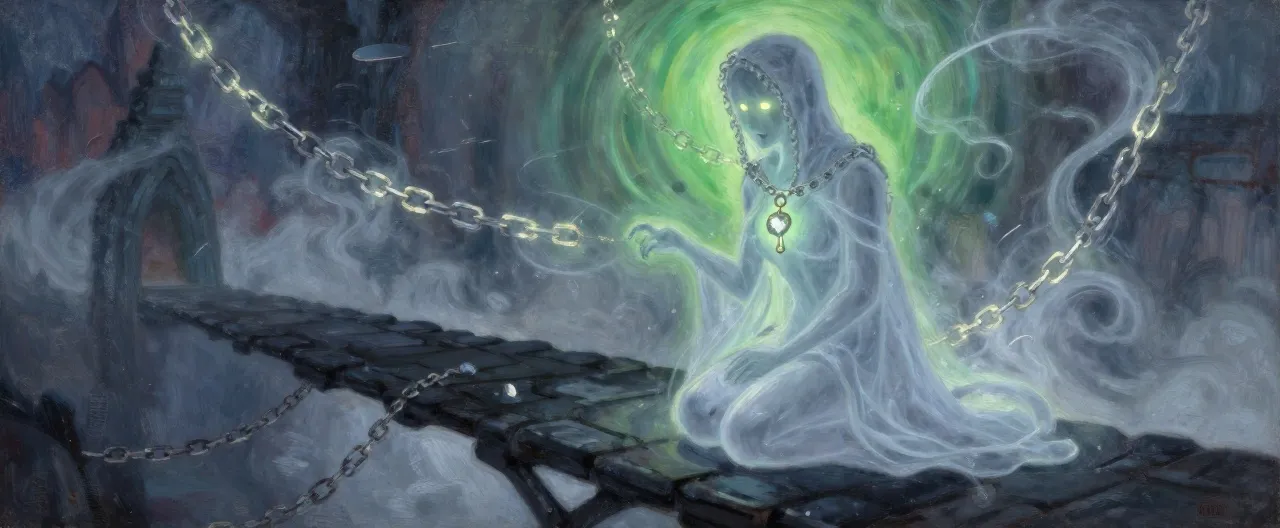
Before the Phantom Zone existed, there was Aethel, god of chains, oaths, and just confinement. In the old order of the material plane, Aethel's temples did not merely punish the guilty—they bound them in vows of restitution, forging each criminal's sentence as a literal chain of iron links, one link for every victim, forged by temple smiths like the young Kaelen. A chain that bound was also a chain that could be unlinked, link by link, as the prisoner performed acts of genuine repair.
This was Aethel's core theology: the chain that binds is also the key. Prisoners who completed their restitution walked out of the temple gates freely, their chains melted down and recast as temple bells, whose tones were said to carry Aethel's forgiveness across the city.
Malakar was Aethel's high priest for twenty years—the god's most trusted voice among mortals, brilliant, charismatic, and quietly starving. Malakar had risen from nothing, and the theology of earned mercy infuriated him: it meant that the worst criminal, given time, could stand equal to the purest saint. He came to believe that guilt should not be released but harvested—that a soul's remorse was the most potent fuel in existence, and that a god who gave it away freely was squandering divinity.
When Aethel refused Malakar's proposal to bind souls permanently and feed on their guilt eternally, Malakar did the unthinkable: he turned the god's own sacrament against him. Using the temple's binding rites, perfected over generations for willing penitents, Malakar bound Aethel himself—chain by chain, link by link—and carved the god's essence apart, keeping the portions that governed judgment and punishment, and casting off the portions that governed mercy and release.
The consumed portions became Malakar's power and the Phantom Zone itself: a demiplane phylactery built from Aethel's own dominion, a prison of chains designed by the god of chains, now twisted into an engine of guilt. The cast-off portions—the mercy, the hope, the memory of every prisoner ever freed—did not die. They coalesced in the deepest chamber of the new Zone, at the foot of the Core of Guilt, into a remnant: the Echo.
Too small to act, too bound to leave, the Echo spent thirty years hovering an inch above the black stone bridge, listening. It heard every prayer muttered in the cell blocks—Lira's nightly devotions, the Penitents' rites, the Breakers' curses—and it could answer none of them. That enforced silence is the Echo's deepest wound, deeper even than the binding itself.
The Echo's relationship to Malakar is its central paradox. It remembers loving him. Aethel's memories include twenty years of genuine friendship, trust, and pride in his priest's brilliance. The Echo does not hate Malakar; it grieves for him, and this grief makes it the only being in the Zone capable of offering Malakar honest redemption—because it alone knows that Malakar was not always a monster, and that the man who bound a god once wept at the temple's dawn rites. The Echo's shadow—the kneeling, weeping priest—is the visible scar of this love betrayed, and the Echo refuses to hide it.
The Echo's theology has evolved in captivity. Originally, it believed binding was mercy and release was earned. Thirty years of watching Malakar's corrupt trials—innocents framed to feed the Core, guilt manufactured rather than confessed—have taught the Echo that compulsion corrupts even sacred institutions. Its counsel now centers on a single principle: a chain is only just when the bound soul can see the key. This is why it never forces the players' hand. It presents the truth, shows the consequences, and trusts the choice to them, because it has learned that divinity imposed is just another tyranny.
The Echo's power is real but finite. Its Channel Divinity draws on the residual faith of the Penitents; its Chain of Memory can replay any crystal record truthfully, because truth was Aethel's first sacrament; its Whisper of the Unbroken Chain grants honest visions of consequences without dictating choices. But the Core of Guilt grows year by year as Malakar harvests souls, and the Echo diminishes with it—its telepathic range shrinking, its form thinning.
The Echo knows it is dying by degrees, and it has made peace with this: its purpose was never to survive, but to be present, one last time, when someone finally stands in the Core and must choose between redemption and destruction. Everything it does—every quest it sets, every secret it guards, every prayer it finally answers—is preparation for that single moment of the Last Counsel, when it will speak one final time and then, by its own deepest rule, fall silent and let the players decide.