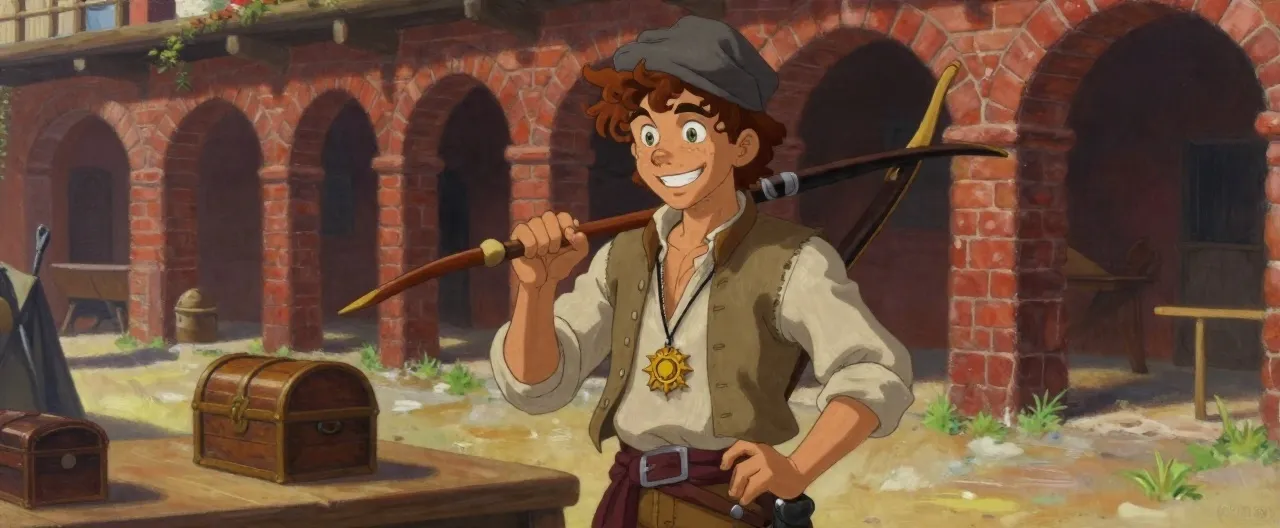
Cenn Vaughan was born in the arcades of Saltport, the red-brick port where the river meets the salt pans, and the arcades raised him because nobody else did. His mother died of the salt-cough when he was six; his father was a tinker who walked the Harvest Road one autumn and did not walk back. By nine he was working the bookmakers' tables under the central arcades, running numbers and lifting purses, and by twelve he was the best spotter the Chain Market's bookmakers had — a small, quick boy who could look at a crowd of buyers and tell them which captive would fetch what, and who was paid in coppers and taught not to ask what happened after the gavel.
He learned letters from a Lamp-order sister named Marguerite Ash, who traded reading lessons for the theft of her own stolen prayer book, and he learned Thieves' Cant from the runners, and he learned the shape of the warehouses along the east wharf the way other children learn the shapes of clouds.
The day that broke him was an ordinary auction day three years ago. Cenn was seventeen, skimming coppers from the take as he had done a hundred times, when Gresh Kettle himself caught the shortfall. Gresh did not beat him. Gresh did something worse: he made the boy stand at the block and watch the day's sales, all of them, as an object lesson in where money comes from. Lot forty that day was Derry Vaughan, Cenn's cousin — a halfling tinker taken off the Harvest Road with a broken ankle, chained in the east wharf warehouses, gone quiet in the way the quiet ones go quiet.
Gresh read the lot number himself in that genial, reasonable voice, and when it was done he told the boy to keep his mouth shut or he would be lot forty-one. Cenn kept his mouth shut for exactly one night. Then he stole the sergeant's tally-stick off his belt, climbed the warehouse roof he knew better than the Chain did, and ran up the Harvest Road with nothing but the stick and the shame.
He has been running the road ever since. Small jobs for Hurley Hill, the dockmaster who falsifies Chain manifests and sweats like a man one audit from a knife. Carrying letters, lifting keys, counting crates — nothing that burns, nothing that shouts. And all the while, on a wax tablet under his vest, Cenn keeps his list: every name he has heard read off the block, scratched in a hand that got steadier as the list got longer.
He wants the Chain's ledger more than he wants the money in it — the book in the harbormaster's strongbox behind the auction block, the one that names every marked captive and the buyer in Castillo. He does not know yet that the buyer is a deacon of the Basilica. He does not know that the ledger's last page records a forge. He only knows that somewhere in that book is a line with his cousin's name on it, written by someone who thought Derry Vaughan was an entry and not a person, and that reading that name out loud — in daylight, in the arcades, where the Chain cannot reach — is the only prayer Cenn Vaughan has ever believed in.
He fell in with the party in Valleyford, the way road-people fall in with each other: the sorceress who burns things and the cleric who believes in second chances were going to Castillo, and Castillo is where the ledger's buyer lives, and Cenn has never once in his life walked away from a debt. So he signed on with Matilda Keene's caravan, thumbed his stolen stick for luck, and started whistling his two-note tune.
He jokes through fear because fear is the only constant on the Harvest Road, and he is kind in small, deniable ways — a copper in Nell Draper's pot, a blind eye turned for a runaway — because kindness is the other constant, and he learned both lessons in the same arcades.