Basilisk
huge beast, unaligned
D&D 5.5 / SRD 5.2
This monster will be deleted in 6 days. Create a free account to claim all your generated content.
Defense
Treasure & Loot Rare Loot
Garnet (117 gp)
Proficiencies & Senses
Characteristics
Appearance & presence
Monster Description
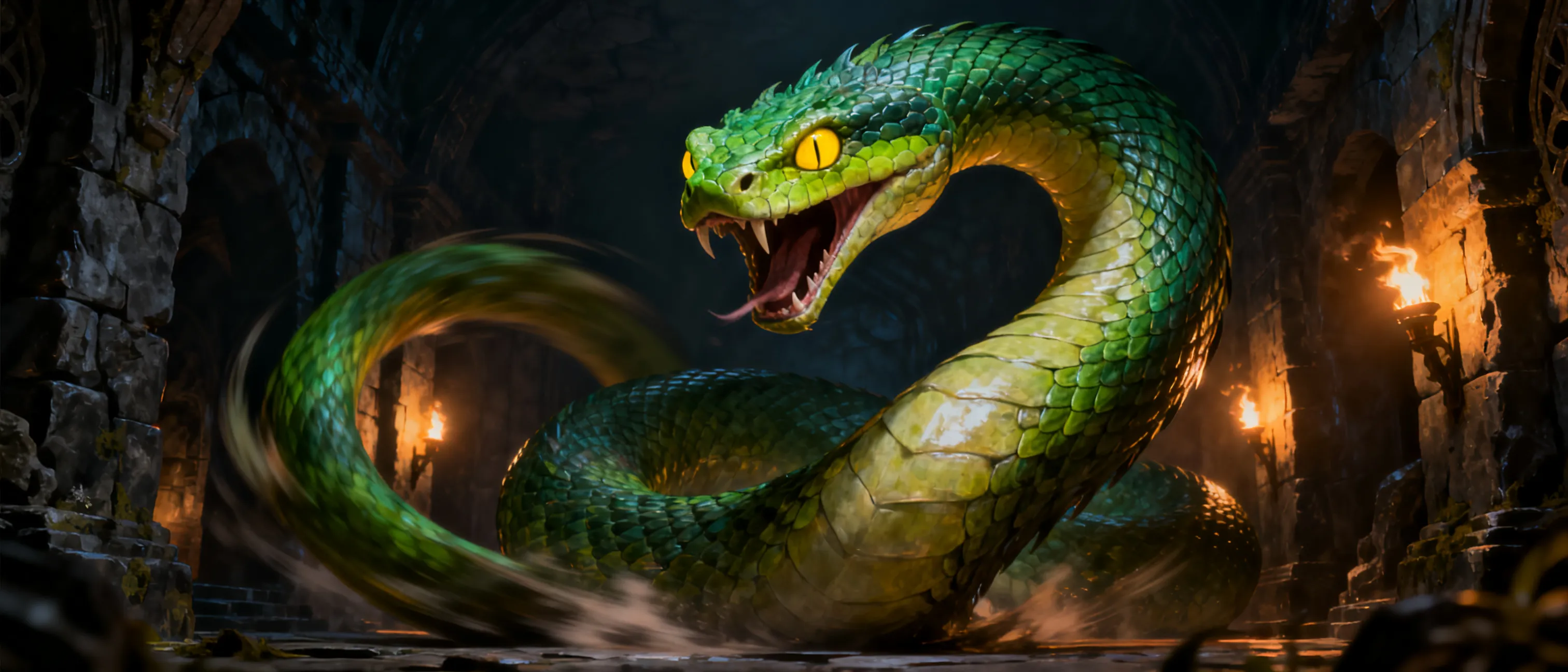
The Basilisk is a terrifying apex predator, resembling a colossal serpent with scales that shimmer in iridescent hues of emerald and obsidian. Its body is thick and muscular, capable of crushing stone beneath its weight as it slithers across the ground with unsettling silence. The creature’s head is broad and flat, dominated by two large, unblinking eyes that glow with a sickly yellow luminescence. These eyes are not merely for sight; they are conduits for a petrifying gaze that turns living flesh to stone upon direct contact.
When agitated, the Basilisk rears up, exposing rows of needle-like fangs dripping with potent venom. Its movement is fluid yet heavy, accompanied by the dry rustle of scales against rock and the low, guttural hiss that vibrates through the air like a warning bell. The sound is deep and resonant, often felt in the chest before it is heard by the ears. In dim light, the creature appears as a shifting shadow, but under torchlight, the vibrant green of its hide stands out starkly against the darkness.
It possesses a long, powerful tail used for balance and sweeping attacks, ending in a blunt tip that can shatter bone. The overall impression is one of ancient, predatory malice, a beast designed by nature or magic to dominate its environment through fear and fatal stillness.
Instincts & motives
Monster behavior
Basilisks are solitary hunters driven primarily by instinct and hunger, though they exhibit a cunning patience when stalking prey. They rarely initiate conflict unless provoked or hungry, preferring to ambush unsuspecting travelers from rocky crevices or subterranean tunnels. Their primary defense mechanism is their petrifying gaze, which they use to freeze opponents before closing in for the kill. However, if blinded or facing reflective surfaces, they rely on their physical strength and venomous bite.
Socially, they are territorial rather than communal, engaging in violent clashes only during mating seasons or disputes over prime hunting grounds. They react aggressively to loud noises and bright lights, perceiving them as threats to their sensory dominance. Despite their ferocity, they are not mindless killers; they assess threats carefully, often retreating if overwhelmed. They show no mercy to intruders who violate their space, turning victims into statues as trophies or warnings. Their behavior suggests a high level of predatory intelligence, allowing them to set traps and utilize terrain effectively to isolate targets before striking.
Habitat & life cycle
Ecology
Basilisks thrive in dark, enclosed environments such as underground caverns, ancient ruins, and dense forests where sunlight is scarce. Their diet consists mainly of large mammals and other beasts, which they paralyze with their gaze before consuming slowly over several days. This feeding habit allows them to survive periods of scarcity by storing energy in their massive bodies. Biologically, they are oviparous, laying eggs that require specific magical or geothermal heat to incubate, often leading to conflicts with other creatures guarding these sites.
Their poison immunity stems from a unique metabolic process that neutralizes toxins, making them resistant to many venoms found in their habitat. Ecologically, they serve as population control for herbivores in isolated regions, preventing overgrazing in their territories. The presence of a Basilisk often signals a disrupted ecosystem, as their predation pressure forces other species to migrate or adapt rapidly. Their interaction with magical elements is profound, as their petrification ability is believed to be a biological manifestation of transmutation magic, affecting the cellular structure of living tissue instantly.
Origins & legends
History
Legends speak of the Basilisk originating from the accidental union of a serpent’s egg hatched under a toad’s brooding, a myth popularized by alchemists seeking to explain its unnatural powers. Historically, sightings have been reported in the catacombs beneath major cities, where they were initially mistaken for dragons due to their size and lethality. One famous account describes a Basilisk nesting in the Chamber of Secrets, a subterranean vault built by an ancient sorcerer to test his greatest creation.
This event led to the closure of the chamber and the subsequent disappearance of the creature for centuries. Local folklore warns travelers never to look directly at yellow-eyed serpents in dark caves, attributing numerous disappearances to this rule. Adventure hooks abound, including expeditions to recover artifacts lost to petrified explorers or quests to eradicate a Basilisk threatening a mining operation. The creature’s history is intertwined with tales of hubris, where mages attempted to harness its power, only to become its first victims.
Ready to Unleash Your Dungeon Master Potential?
Join thousands of DMs and turbocharge your campaign preparation with Fable Fiesta!
Register, and get access to monster abilities, combat behaviour and lore!
Sign Up Now - It's Free!No credit card required. Start writing in minutes!