Rotwing Carrion Crow
small beast, unaligned
D&D 5.5 / SRD 5.2
This monster will be deleted in 6 days. Create a free account to claim all your generated content.
Defense
Treasure & Loot Common Loot
Proficiencies & Senses
Characteristics
Running the encounter
Combat Behavior
Appearance & presence
Monster Description
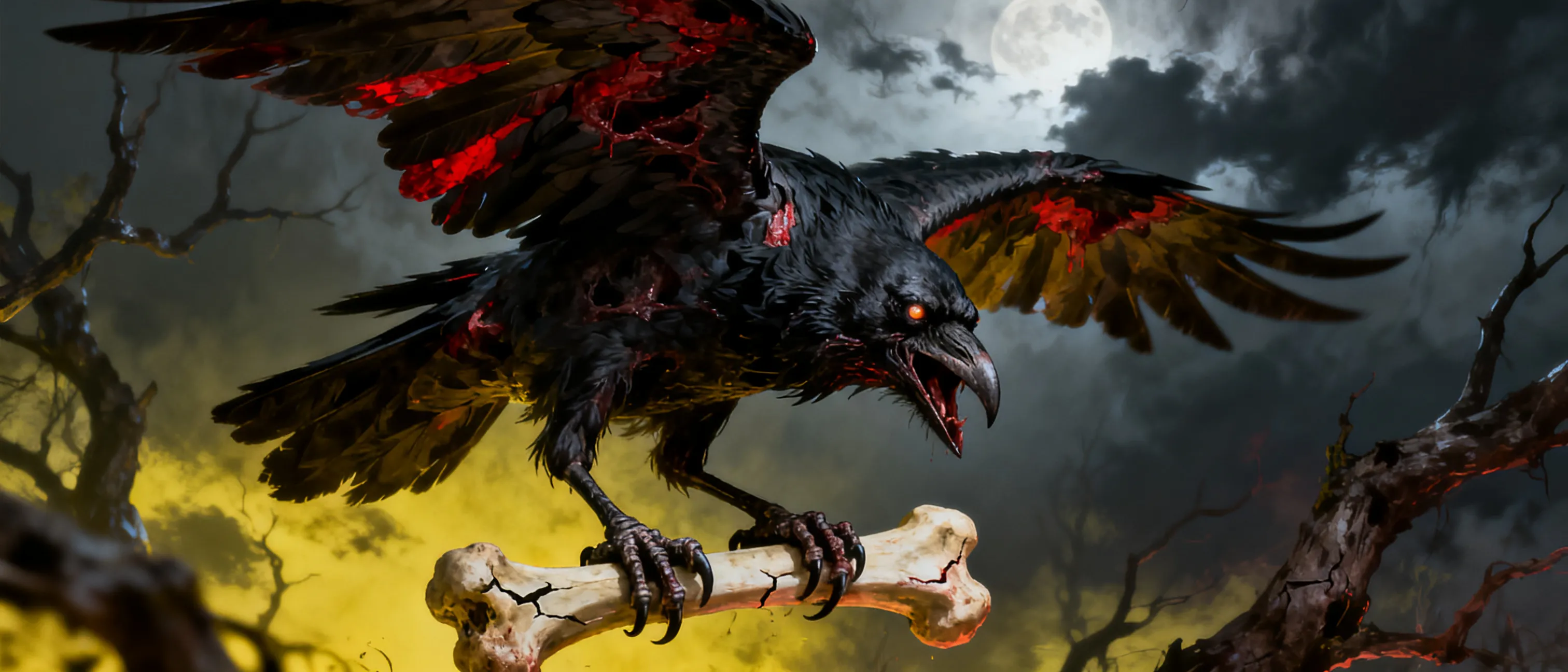
The Rotwing Carrion Crow is a disturbing aberration of nature, appearing as an oversized corvid whose plumage tells a tale of decay and malice. Its feathers are not the sleek, iridescent black of healthy birds but a matted, ragged mess that clings to its skeletal frame like wet tar. In several places along its wings and chest, the skin has sloughed away entirely, exposing raw, pulsating red flesh that weeps a faint, acrid ichor.
This exposed tissue glistens with a sickly sheen, contrasting sharply against the dull, dead feathers surrounding it. The creature’s eyes are its most unsettling feature; they glow with a malevolent crimson light, devoid of pupil or iris, radiating a hunger that seems to pierce through darkness. When perched, the crow hunches low, its claws gripping branches or bones with unnatural strength despite its frail appearance. Its beak is slightly curved and stained dark, often clicking together in a rhythm that mimics the cracking of small bones.
Movement is jerky and erratic, characterized by sudden head tilts and spasmodic wing flaps that produce a wet, tearing sound rather than the smooth rush of air. A distinct odor accompanies the creature—a cloying mix of rotting meat, stagnant water, and old blood—that serves as an early warning to sensitive noses. The silhouette is jagged and uneven, lacking the aerodynamic grace of normal birds, giving it the appearance of a living scarecrow animated by necromantic spite.
Instincts & motives
Monster behavior
Rotwing Carrion Crows operate with a predatory intelligence that belies their low Intelligence score, driven primarily by an insatiable compulsion to consume carrion and spread disease. They are highly territorial around feeding grounds, particularly graveyards, battlefields, and slaughterhouses, where they gather in loose flocks known as 'murders.' Unlike natural crows, which may scavenge opportunistically, Rotwings actively seek out weakened prey, circling victims for hours to test defenses and gauge stamina before striking.
They exhibit a macabre curiosity, often dropping shiny objects or fragments of bone onto intruders to distract them while allies flank from above. Social interactions within the flock are hierarchical and brutal; dominant birds peck at subordinates until submission is shown through lowered heads and tucked wings. When threatened, they rarely flee immediately. Instead, they emit a shrill, discordant caw that sounds like screaming metal, intended to disorient foes and summon reinforcements.
If outnumbered, they will retreat to high vantage points, using stealth and camouflage among shadows to monitor threats. Their motivation is not survival alone but propagation; they instinctively carry infected offal to new areas to create future food sources, acting as unwitting vectors for plague. They show no mercy to injured creatures, viewing pain as a signal of impending death and thus, immediate opportunity.
Habitat & life cycle
Ecology
These creatures thrive in environments saturated with death and magical corruption, such as blighted lands, abandoned crypts, and cursed forests. While biologically classified as Beasts, their physiology suggests a parasitic relationship with necrotic energy. They sustain themselves on rotting flesh, but their digestive systems are uniquely adapted to process material tainted by negative energy planes, allowing them to survive on food that would kill ordinary animals. This diet grants them their resilience and eerie vitality.
In the wild, they serve as scavengers, accelerating decomposition, though their presence often indicates deeper ecological imbalance. They have few natural predators due to the toxicity of their flesh; larger beasts avoid eating them, fearing sickness. Reproduction is rare and grim; females lay eggs only in nests constructed from human hair and finger bones, incubating them with body heat generated by their own decaying metabolism. Chicks hatch fully feathered but blind, relying on the parents' regurgitated infectious matter for sustenance.
Their interaction with other species is largely antagonistic; they compete fiercely with regular crows and ravens, often driving them out of shared habitats through sheer aggression and disease transmission. Magical equivalents include constructs designed to mimic their behavior for espionage, though these lack the biological unpredictability of true Rotwings.
Origins & legends
History
Local legends suggest the first Rotwing Carrion Crow emerged during the Great Plague of Ashenmoor, when a failed necromancy ritual combined with widespread pestilence twisted common birds into these abominations. Originally confined to the catacombs beneath the city, they eventually escaped following a collapse that exposed their nesting grounds to sunlight and wind. Historians note that armies often avoided marching through regions infested with Rotwings, not just for fear of attack, but because the birds were seen as harbingers of doom.
In recent years, adventurers have reported sightings far beyond the original plague zones, leading scholars to suspect that a cult dedicated to entropy is breeding them intentionally. One notable account involves a village elder who claimed his livestock died overnight after a single Rotwing landed on his roof, whispering secrets of the dead into the ears of sleeping farmers. This history provides adventure hooks involving investigations into mysterious livestock deaths, tracking the spread of a supernatural plague, or confronting a necromancer who uses these birds as spies and disease carriers. The creature’s existence challenges the boundary between natural evolution and arcane corruption, making it a focal point for druids seeking to restore balance and clerics battling undead influence.
Ready to Unleash Your Dungeon Master Potential?
Join thousands of DMs and turbocharge your campaign preparation with Fable Fiesta!
Register, and get access to monster abilities, combat behaviour and lore!
Sign Up Now - It's Free!No credit card required. Start writing in minutes!